
More about Pac Bo


Panoramic view of Pac Bo. Photo: Duc Hoang
The main natural areas and historic sites of Pac Bo
Exploring this historic sanctuary follows a shaded walking route linking the springs to the rock shelters.
Activities and sights along the Le-nin stream

Photo: VOV
The walk through the site begins along the Le-nin stream (suoi Le-nin), named by Ho Chi Minh in tribute to the political theorist. The stream immediately strikes travellers with its intense turquoise colour and the absolute transparency of its water, through which you can clearly see shoals of local fish swimming over a bed of white pebbles and bright green moss. The route follows a path paved with flat stones that follows the meanders of the stream, passing beneath arbours of giant bamboo and century-old forest trees.

Photo: Duc Hoang
Visitors walk quietly along the water's edge, enjoying the coolness of the current while looking at the preserved features of daily life, such as the natural stone table where the leader sat to write documents or the grassy spot where he went fishing. This walk to the murmur of the water offers a striking visual immersion, as the mineral gleam of the limestone and the clarity of the stream contrast sharply with the dense vegetation of the surrounding mountain.
Reaching and discovering the Pac Bo cave
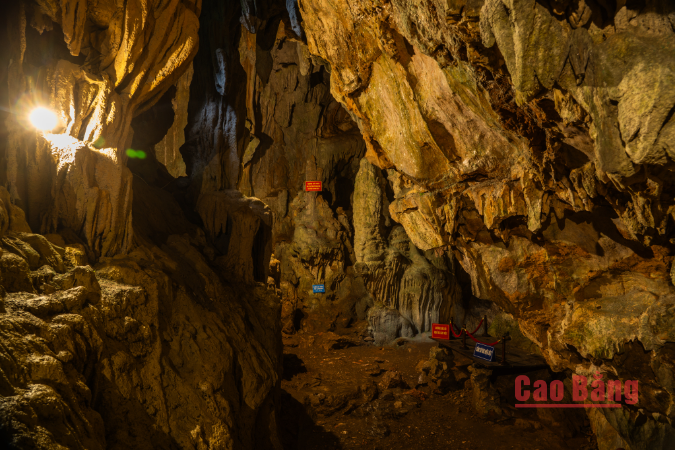
Photo: Cao Bang Journal
Following the stream back to its underground source, walkers reach the Pac Bo cave (hang Pac Bo), also known locally as hang Coc Bo, which means "the mouth of the spring" in the language of the Tay ethnic community. The cave is reached by a steep, narrow stone staircase cut into the limestone face. Inside, the cave turns out to be particularly cramped, dark and cool, with an area of barely fifteen square metres, where constant humidity makes water bead along the stalactites.
Travellers can see the spartan, clandestine living conditions of the revolutionary leader: a rough wooden plank serving as a bed, traces of an earthen cooking hearth and a natural human-shaped stalagmite that Ho Chi Minh carved and named the statue of Karl Marx. Visiting this rock chamber shows the strategic isolation of the place: the small entrance gives a perfect view of the path below while remaining completely invisible from the valley, an ideal defensive position for escaping the colonial patrols of the time.
Observing the karst ecosystem and local ways of life
The steep slopes surrounding the Pac Bo valley are an ideal place to observe the geomorphology of northern Vietnam. Visitors can admire sharp limestone peaks blocking the horizon, typical of Cao Bang's landscapes, covered with tough forest vegetation adapted to poor rocky soils. Around the memorial area, meeting members of the Tay and Nung communities, dressed in their traditional indigo tunics, introduces you to mountain crafts and subsistence farming, notably maize grown on the steep slopes and family livestock rearing. Several small stalls run by locals near the entrance offer rustic dishes, such as sticky rice cooked in bamboo tubes or smoked pork, providing a direct link to the rural culture of the border region.
Seasons and hydrological indicators for the visit
The visual experience and walking comfort at Pac Bo are closely linked to the monsoon calendar of northern Vietnam. The ideal period to plan this itinerary runs from September to April, during the dry season and the northern winter. During these months, rain is rare, the risk of slipping on the wet steps of the cave is minimal and the Le-nin stream shows its purest turquoise because there is no muddy sediment washed down by the rain. Average temperatures range between 15°C and 22°C, so bring warm clothing, especially for the morning. The rainy season, from May to August, brings torrential downpours that suddenly swell the stream, turning it a more opaque reddish colour and making access to the caves slippery and sometimes restricted for safety reasons.
Preserving a link between history and nature
The Pac Bo complex represents a well-preserved balance between safeguarding a major national historic site and protecting a mountain forest environment. Stone footpaths and electric buggies at the entrance have helped channel visitor flows while maintaining the silence the solemnity of the place requires. By keeping the waters of the Le-nin stream absolutely clean and following the instructions to be discreet inside the Pac Bo cave, every traveller actively helps conserve this dual heritage, ensuring that the purity of this limestone landscape remains intact for future generations.
You might also be interested in:


