
Nha Trang: the jewel of the central coast between ancient city and modern riviera
Located in the heart of Khánh Hòa province, on the south-central coast of Vietnam, the seaside city of Nha Trang is one of the great jewels of the Indochinese coastline. Sheltered by a ring of green mountains and embracing a spectacular bay ranked among the most beautiful in the world, the city offers a striking contrast between the gentleness of its sandy arc several kilometres long and the ruggedness of its granite islands. Once part of the kingdom of Champa under the name Kauthara, Nha Trang harmoniously combines a rich ancient spiritual heritage, the elegance of its colonial buildings and the vitality of a modern seaside resort turned towards the ocean.
Five iconic sites to discover during a stay in Nha Trang
1. The Po Nagar Towers (Tháp Bà Po Nagar): the sacred sanctuary of the kingdom of Champa

Photo: Nguyen Thanh Nhon
Standing majestically on Cù Lao hill by the Cái river, the Po Nagar religious complex is one of the most fascinating architectural and spiritual testimonies of the Champa civilisation in central Vietnam. Built between the 8th and 11th centuries, this Hindu sanctuary was dedicated to the goddess Yan Po Nagar, regarded as the "Mother of the Land", creator of the earth, trees and rice, who taught farming and weaving to the people of the region. Of the ten structures that made up the site at its height, four red-brick towers still stand proudly facing the sea. Most impressive is the main tower (Tháp Chính), nearly 23 metres high, whose carved façade bears intricate depictions of Shiva and other Hindu deities. One of the great mysteries of the complex lies in the Cham builders' technique: the fired bricks fit together so perfectly that the joints of plant resin are practically invisible to the naked eye. Even today the temple keeps an intense spiritual fervour, where ancestral Cham rites mingle with Buddhist prayers.
-
Practical tip: To enter the prayer sanctuaries and admire the ancient stone statues bathed in incense smoke, wear covering clothes (shoulders and knees covered) or borrow a traditional robe provided free at the entrance. The outer courtyard also hosts daily performances of traditional Cham dance, accompanied by the Garanung drum and the Saranai flute.
-
Address: 2 Tháng 4 street no. 2, Vĩnh Phước ward, Nha Trang city, Khánh Hòa province.
2. Long Sơn Pagoda (Chùa Long Sơn): the spiritual heart and the Great White Buddha
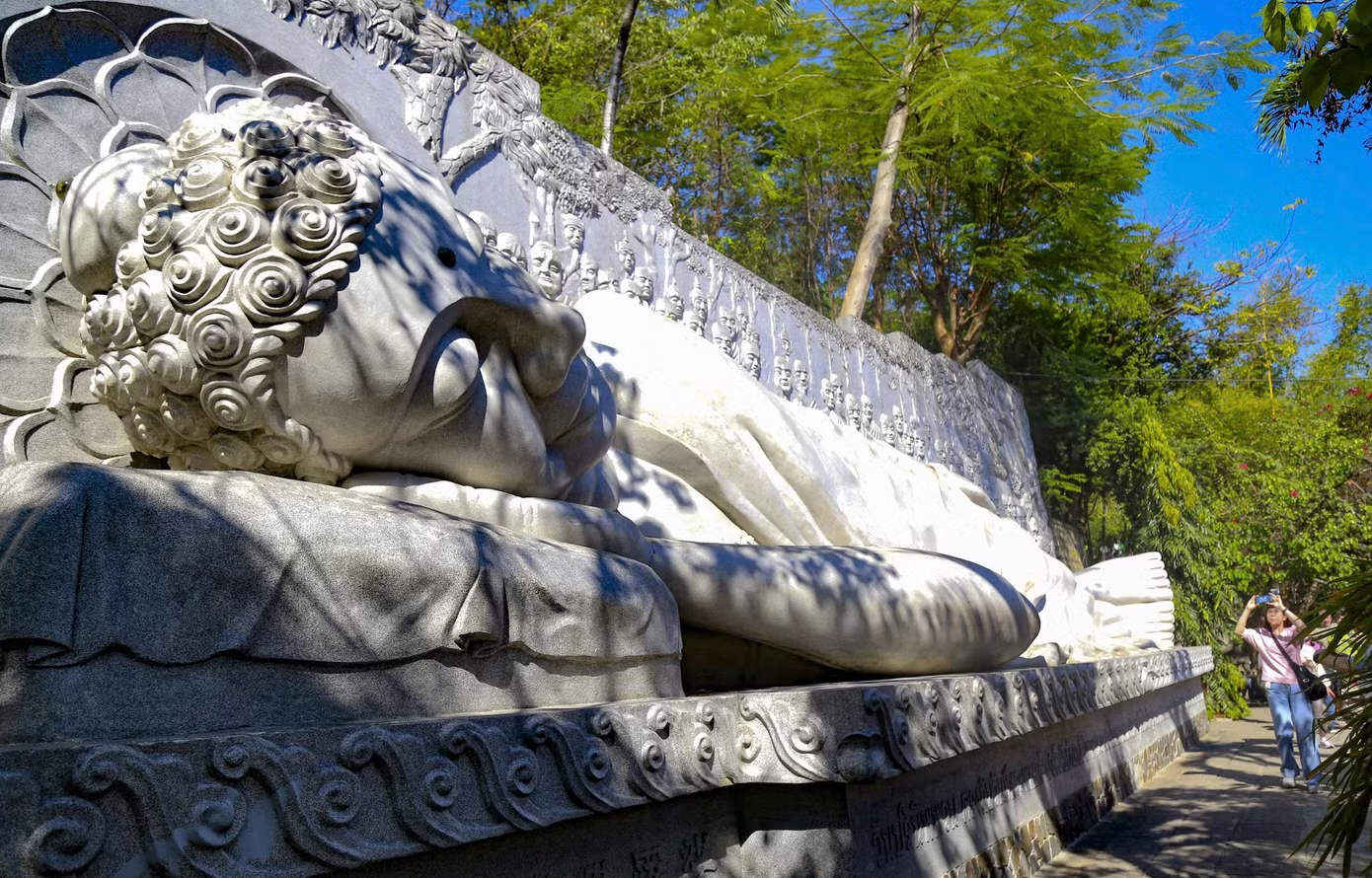
Photo: Phung Quang - Truong Dinh
Founded at the end of the 19th century as Đăng Long Đường, then rebuilt in 1900 at the foot of Trại Thủy hill, Long Sơn pagoda is the nerve centre of Buddhism in Khánh Hòa province. As soon as you pass through the three-arched entrance gate (Tam quan), you are plunged into a serene atmosphere shaded by century-old banyans and meticulously kept gardens. The architecture of the main sanctuary shows the finesse of traditional Vietnamese craftsmanship, with yin-yang tiled roofs topped by dragons in ceramic and coloured-glass mosaic. The real highlight is at the top of the hill: after climbing an imposing flight of 193 stone steps, you discover Kim Thân Phật Tổ, a dazzling white reinforced concrete statue of Gautama Buddha seated in meditation on a lotus flower. 24 metres high, this iconic monument is visible from almost every part of the city. Around the octagonal base, carved bas-reliefs pay poignant tribute to the seven monks and nuns who set themselves on fire in 1963 in protest against religious persecution under the South Vietnamese regime.
-
Practical tip: Stop halfway up to admire the large statue of the Buddha in parinirvana (reclining), surrounded by a fresco of his mourning disciples. The upper terrace also offers an exceptional 360-degree view over the whole of Nha Trang, the bay and the surrounding mountains.
-
Address: 22 Thái Nguyên street, Phương Sài ward, Nha Trang city, Khánh Hòa province.
3. Christ the King Cathedral (Nhà thờ Núi): neo-Gothic elegance on its promontory
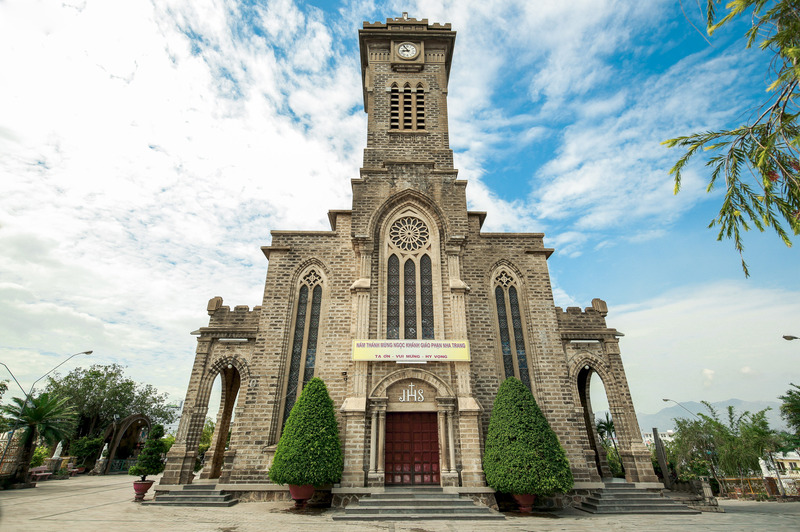
Photo: Tran Anh Khoa
Surprising with its Western architecture in a tropical setting, Christ the King Cathedral - affectionately called the "Mountain Church" (Nhà thờ Núi) by locals - looks down on the station square from its rocky spur. Built between 1928 and 1933 at the instigation of the French priest Louis Vallet, it required part of Bông hill to be dynamited to create a flat building surface. Contrary to what its popular name suggests, the building was not carved from natural stone but built entirely of moulded concrete blocks, an innovative technique for the time that gives it the austere, majestic grey hue of medieval European cathedrals. The main façade is flanked by a 38-metre square bell tower topped with a large cross and a monumental clock. Inside, the high pointed-vaulted nave is lined with beautiful stained-glass windows imported from France depicting scenes from the life of Christ and the apostles, which filter the harsh tropical sunlight into a hushed, mystical atmosphere.
-
Practical tip: Tourist access is suspended during daily masses. Visit early in the morning or late in the afternoon, when the forecourt fills with worshippers and the low light brings out the flying buttresses and rose windows.
-
Address: 1 Thái Nguyên street, Phước Tân ward, Nha Trang city, Khánh Hòa province.
4. Nha Trang Oceanographic Institute (Viện Hải dương học): a century of marine science
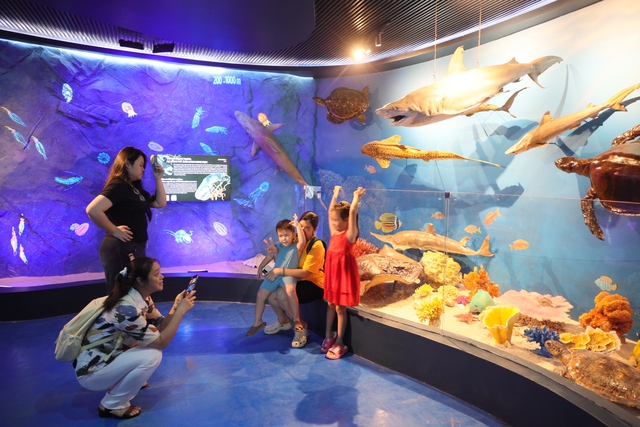
Photo: F.D
Founded in 1922 under the French administration and ideally located near Cầu Đá port, Nha Trang Oceanographic Institute is one of the oldest and most important marine science research centres in South-East Asia. Housed in a large complex of remarkable colonial buildings, the site combines a still-active research laboratory with a museum open to the public. The visit begins with large historic tanks and aquariums holding hundreds of living species from the East Sea and the Pacific: reef sharks, rays, giant sea turtles, clownfish in their anemones, lionfish and seahorses. But the museum's real wealth lies in its extraordinary scientific collection of more than 20,000 marine specimens preserved in formalin jars or mounted. The highlight is the spectacular skeleton of an 18-metre humpback whale weighing nearly 10 tonnes, dug up inland in Bắc Kạn province in 1994, a testament to the peninsula's major geological changes.
-
Practical tip: A particularly fascinating and cool visit to plan during the hottest hours of the day. Don't miss the section devoted to the marine heritage of the Hoàng Sa (Paracel) and Trường Sa (Spratly) archipelagos, presenting the rare reef fauna of these very well-preserved areas.
-
Address: 1 Trần Phú street, Vĩnh Nguyên ward, Nha Trang city, Khánh Hòa province.
5. Hòn Mun Island marine reserve (Đảo Hòn Mun): the bay's underwater sanctuary
Located about ten kilometres south-east of the city centre, Hòn Mun island owes its name to its imposing jet-black granite cliffs (mun means "black" in Vietnamese) that plunge steeply into crystal-clear waters. Recognised as Vietnam's first marine protected area in 2001, the island shelters an underwater ecosystem of exceptional richness, rivalling the finest dive sites in South-East Asia. The seabed around the island is home to more than 350 species of reef-building coral (over 40% of the coral species recorded worldwide), forming huge reefs where thousands of colourful reef fish, sea turtles, sea fans and crustaceans live. Because of its geology, the island also has many rock cavities where swiftlets nest, and their nests are harvested according to centuries-old traditions.
-
Practical tip: Whether you prefer scuba diving or snorkelling, choose an excursion leaving early in the morning from Cầu Đá port. Underwater visibility is best between March and August, when the sea is calm and sunlight penetrates deep through the turquoise water.
-
Address: Nha Trang bay (access by sea from Cầu Đá port / Nha Trang international port).
Culinary specialities of Nha Trang: 4 local must-tries
1. Rice vermicelli soup with fish cakes
This emblematic Nha Trang breakfast dish combines a clear, fragrant broth simmered with rock fish bones and small fish, thin rice noodles (bún) and artisanal fish cakes (chả cả). Made from seasoned, pan-fried mackerel or grouper, these cakes bring a firm, tasty texture, all lifted by crunchy jellyfish (bún sứa) and fresh herbs.
2. Grilled pork skewers
Originally from neighbouring Ninh Hòa district but now the king of street food in Nha Trang, nem nướng are skewers of marinated minced pork grilled over charcoal. They are eaten as do-it-yourself spring rolls: the meat is rolled in thin rice paper with crispy fried dough (ram), tangy green mango, cucumber and herbs, then dipped in a smooth hot sauce made from sticky rice and pork liver.
3. Seafood Bánh Căn
These small crispy rice-batter cakes are cooked one by one in honeycomb clay moulds heated over charcoal. In Nha Trang, each little dome is topped with fresh prawns from the bay, small whole squid or quail eggs. They are eaten piping hot, dipped in a bowl of diluted nước mắm or a fish-broth sauce with pork meatballs (xíu mại).
4. Khánh Hòa bird's nest
Considered the province's "white gold", swiftlet nests harvested from the rocky cliffs of the bay's islands (notably Hòn Nội and Hòn Ngoại) are renowned throughout Asia for their purity. Traditionally prepared as a sweet soup with rock sugar and lotus seeds (yến chưng đường phèn), this exceptional delicacy, famed for its fortifying virtues, is the quintessence of the Khánh Hòa terroir.
When to visit Nha Trang?
Enjoying a particularly mild microclimate thanks to the Annamite range, which blocks part of the monsoons, Nha Trang has the longest dry season in central Vietnam:
-
The ideal period (January to August): Sunshine dominates, the sky is clear and the sea stays very calm and transparent. February to May is especially pleasant for cultural visits with mild temperatures (24 °C to 28 °C), while June to August offers perfect summer conditions for swimming and diving.
-
The rainy season (September to December): With more frequent showers and coastal low-pressure systems, this period can bring bigger waves and reduce underwater visibility around the islands, although temperatures remain mild.
A major stop on the central Vietnamese riviera
Ideally located on the coastal road linking Quy Nhơn to Phan Thiết and served by Cam Ranh international airport (35 km to the south), Nha Trang is an essential stop on any itinerary in the south-central region. Between the ancient majesty of the Cham towers of Po Nagar, the freshness of the Hòn Mun coral reefs and the richness of its seafood, the city wonderfully embodies the dynamism and wild beauty of the Vietnamese coast.


