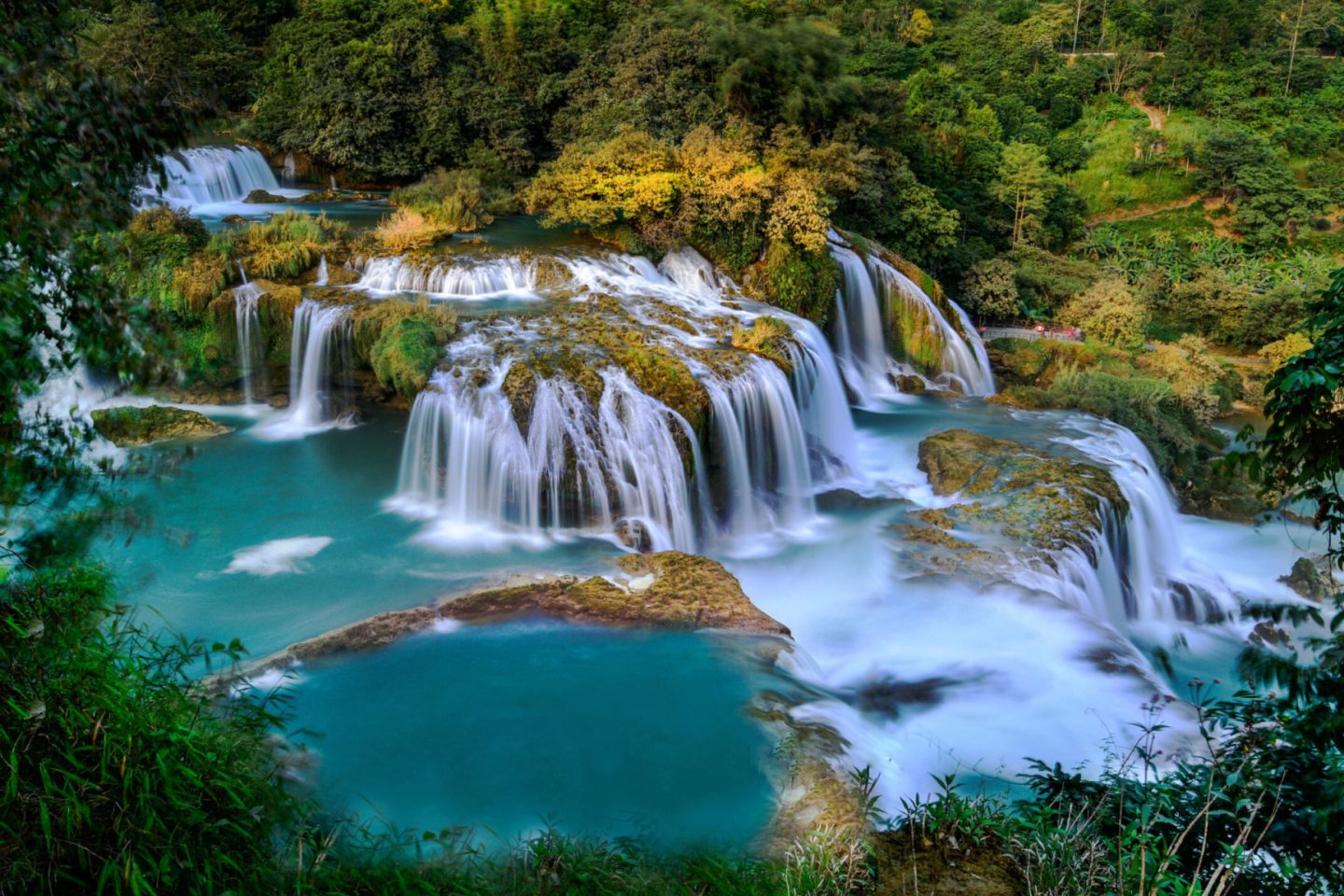

Blazing autumn leaves at Bản Viết lake. Photo: Phạm Hữu Tuyên
1. Bản Giốc Waterfall

Photo: VNA
See also: Bản Giốc waterfall: an epic of water and rock on the nation's frontier
Considered one of the most spectacular waterfalls in all of Southeast Asia, Bản Giốc immediately impresses travellers with its monumental scale. Divided in two by the Vietnam-China border, it tumbles with remarkable force down limestone terraces more than thirty metres high.
In the rainy season, the roar of the water becomes deafening, throwing fine droplets into the air that create a mystical mist over the surrounding rice fields. It is a true natural wonder, whose composition and splendour seem painted by a master of classical art.
2. Ngườm Ngao cave
Just a few kilometres from the waterfall lies Ngườm Ngao, a mysterious cave whose name means « tiger cave » in the Tày language. Stretching for several kilometres beneath the rock, this underground sanctuary offers explorers a display of stalactites and stalagmites of rare delicacy.
From chamber to chamber, age-old rock formations perfectly imitate plant or human shapes, evoking lotus flowers, ships or pine forests. This fairy-tale setting is enhanced by the constant murmur of an underground river system flowing quietly in the darkness.
3. Pác Bó historic site

Photo: Hoàng Tuấn Anh
See also: Pác Bó in Cao Bằng: a walking route between the Lenin stream and the karst caves
Pác Bó is far more than a beautiful natural site; it is a true place of pilgrimage for the Vietnamese soul and memory. It was here, in Cốc Bó cave, that President Hồ Chí Minh settled in 1941, a historic turning point in leading the resistance.
The Lenin stream, with its almost unreal emerald-blue water, flows peacefully at the foot of the towering Karl Marx mountain. Together they form a setting of absolute serenity, where the nation's modern history blends harmoniously with the silence of the mountains.
4. Thang Hen lake
At nearly 1,000 metres above sea level, Thang Hen lake is the beating heart and largest reservoir of a complex system of 36 interconnected lakes. Its great peculiarity, which fascinates geologists, is the constant clarity of its water, preserved even in the flood season.
Tightly ringed by steep cliffs and dense, protective forests, the lake looks like a gem gently set in a green case, offering a peaceful, timeless landscape ideal for contemplation.
5. God's Eye Mountain

God's Eye Mountain is also an ideal place for camping, taking photos and enjoying the view, especially at sunset. Photo: Phạm Khoa
A true geological curiosity and the pride of the province, this unique mountain is pierced right through by an almost perfectly circular hole more than 50 metres across, strikingly like a giant eye watching the valley below. The surrounding site is pure poetry.
At the foot of the mountain stretches a vast, rolling green meadow where horses and buffaloes graze freely. It is a must for travellers seeking surreal photos, and an ideal place to camp, take pictures and admire the scenery, especially at sunset in total calm.
6. Phja Oắc mountain

Photo: Hà Cường
The Phja Oắc massif, rising to nearly 1,931 metres, proudly stands as the roof of Cao Bằng province. It is especially known for its remarkable flora and the ruins of old French colonial villas that bear witness to the past. Wrapped in almost permanent mist that gives it a mystical air, the mountain changes face as the cold season arrives.
In winter, its summit becomes a true kingdom of ice, drawing many visitors to see the white frost beautifully crystallising on the branches of the primary forest.
7. The Mạc dynasty citadel
The remains of the Mạc dynasty citadel, strategically set on Phủ Lừa hill, show the crucial military and political importance of Cao Bằng through the ages. The old stone walls, though partly overgrown by vegetation, silently tell of the intense power struggles that shook the 17th century.
For travellers, climbing the historic steps to the ramparts is well rewarded: it opens onto a breathtaking panoramic view of Cao Bằng city and the mountain silhouettes on the horizon.
8. Khuổi Ky stone village
Khuổi Ky is a unique, timeless village where the pace of the modern world seems to have stopped. Here, the traditional stilt houses of the Tày people are, unusually, built entirely of stone. This architectural tradition goes back several centuries, devised by the ancestors to protect themselves from invaders and from the harsh cold of the highlands.
Every paved lane and every stone wall radiates quiet strength, creating a unique mineral aesthetic that contrasts beautifully with the soft green of the nearby maize fields.
9. Bat Cave
In the border district of Hạ Lang, Bat Cave is a top destination for explorers and adventurers at heart. Far less developed than its neighbour Ngườm Ngao, it keeps a fiercely wild, authentic and mysterious character.
Its vast underground chambers are home to thousands of bats and reveal imposing limestone formations sculpted by time. Getting there is an adventure in itself, through forgotten valleys far from the classic tourist routes.
10. Trùng Khánh periodic market
The Trùng Khánh periodic market offers visitors total sensory and human immersion in the living culture of the Tày, Nùng and Hmong peoples. Beyond trading the famous local chestnuts, rightly considered the best in the country, people come to admire the vivid colours of traditional costumes, breathe in the complex scents of forest spices and enjoy the warmth of the exchanges.
You may also like