More about Da Nang
10 key stops on a stay in Da Nang
1. The sacred Marble Mountains (Ngu Hanh Son): a spiritual sanctuary between rock and ocean

Photo: Nguyen Dong
Rising proudly about 8 kilometres south-east of central Da Nang, this spectacular group of five limestone and marble hills emerges from the coastal plain. Each peak bears the name of one of the five elements of traditional Asian cosmology: Kim (Metal), Moc (Wood), Thuy (Water), Hoa (Fire) and Tho (Earth). Among them, Thuy Son mountain is the largest, the highest and the most spiritual.
Climbing the old stone steps cut into the cliff - or taking the glass panoramic lift -, you enter a sacred world where wild nature mingles with centuries-old places of worship. The route leads to remarkable sanctuaries such as Linh Ung pagoda (the oldest in the city, built under the Nguyen dynasty) and Tam Thai pagoda. The highlight is the majestic Huyen Khong cave: an immense natural underground cathedral where sunlight filters through cracks in the rock vault, lighting Buddha statues carved into the rock in a haze of mist and incense.
Practical tip: Visit early in the morning (from 7 to 8 am) to climb the steps in the shade and enjoy the calm before the groups arrive. Wear non-slip walking shoes, as the marble stone in the caves can be very slippery. At the foot of the site, discover the Non Nuoc stone-carving village, famous for its ancestral marble work (check the origin and bargain over the prices of small souvenirs).
Address: Huyen Tran Cong Chua street, Hoa Hai ward, Ngu Hanh Son district, Da Nang.
2. Son Tra peninsula and Linh Ung Bai But pagoda: the "green mountain" watching over the city

Red-shanked douc. Photo: Pham Phung - Huynh Phuong
Jutting majestically into the South China Sea like a natural shield protecting Da Nang bay from typhoons, Son Tra peninsula is a preserved nature reserve of more than 4,400 hectares. Nicknamed the "green mountain", it shelters a tropical rainforest of exceptional ecological richness, home to hundreds of plant and animal species. It is notably the refuge of the red-shanked douc (Vooc cha va chan nau), an extremely rare and spectacularly coloured primate on the red list of threatened species, considered by primatologists to be "the queen of primates".
On a rocky spur facing the ocean stands the grand Linh Ung Bai But pagoda, the largest religious complex in the city. The sanctuary is famous throughout the country for its monumental statue of the Goddess of Mercy (Quan The Am). 67 metres high - the equivalent of a 30-storey building -, this colossal white sculpture stands on a giant lotus and has 17 floors inside. Her benevolent gaze is turned out to sea to protect sailors and bring serenity to the city.
Practical tip: Access to the upper parts of the peninsula (such as the Dinh Ban Co summit or the century-old tree) is via particularly steep roads. For safety reasons, automatic scooters are strictly banned (only manual motorbikes, off-road vehicles, taxis or private tours are allowed). If you meet monkeys or doucs by the road, watch them from a distance without approaching or feeding them human food.
Address: Tho Quang ward, Son Tra district, Da Nang (about 10 km north-east of the centre).
3. My Khe beach: a ribbon of fine sand ranked among the most beautiful in the world

Photo: Nha Van
Stretching nearly 10 kilometres from the foot of Son Tra peninsula to the edge of the Marble Mountains, My Khe beach is Da Nang's true seaside jewel. Regularly cited by major international media - notably the American magazine Forbes, which ranked it among the most attractive beaches on the planet -, it charms with its very fine white sand, gentle slope into the water, moderate waves and pleasantly warm sea temperature all year round.
Lined with a wide landscaped promenade of coconut palms and green lawns, My Khe offers an exceptional setting. Early in the morning it becomes the stage of local life: residents gather for gym sessions, tai chi or a swim in the first rays of sunshine, while fishermen bring their thung chai (round bamboo boats) ashore. During the day and late afternoon, the beach comes alive with water sports (jet skiing, surfing, sea kayaking, parasailing) and stylish beach bars.
Practical tip: To experience the beach like a local, go between 5 and 7 am to watch the sun rise over the sea. For swimming, choose the late afternoon from 4.30 pm when the heat drops. Always swim in supervised areas marked by the lifeguards' red and yellow flags.
Address: Vo Nguyen Giap / Hoang Sa coastal roads, Son Tra and Ngu Hanh Son districts, Da Nang.
4. Ba Na Hills and the Golden Bridge (Cau Vang): an architectural fantasy in the clouds

Ba Na Hill. Photo: Ba Uoc Phung
Clinging to the summits of the Annamite range on Mount Chua, at 1,487 metres, the Sun World Ba Na Hills complex is a legendary mountain resort, originally created by French settlers in the 1920s to escape the heat of the plain. The site is famous for its unique microclimate, offering the fascinating experience of "four seasons in one day": spring freshness in the morning, summer heat at noon, autumn mildness in the late afternoon and winter cold at night.

Cau Vang. Photo: Pascal
The summit is reached by a network of ultra-modern cable cars holding several world records (including the longest non-stop single-rope cable car). At the top, discover the Golden Bridge (Cau Vang), now a global architectural icon: a 150-metre golden footbridge that seems to be held above the void by two giant moss-covered stone hands emerging from the mountain. The complex also includes a life-size reconstruction of a medieval-style French Village with its Gothic-style cathedral, the beautiful flowering D'Amour gardens, old colonial wine cellars (Debay) and the Fantasy Park indoor amusement park.
Practical tip: Buy your cable car tickets online in advance to avoid queues at the departure station. As it is about 7 °C to 8 °C cooler at altitude than on the coast, bring a light jacket or windbreaker. To capture the perfect photo of the Golden Bridge without crowds, take the very first cable car at 7.30 am.
Address: An Son hamlet, Hoa Ninh commune, Hoa Vang district, Da Nang (about 25 km west of the centre).
5. The iconic bridges of the Han river: architectural art along the water

The Han river. Photo: Quang Nguyen Vinh
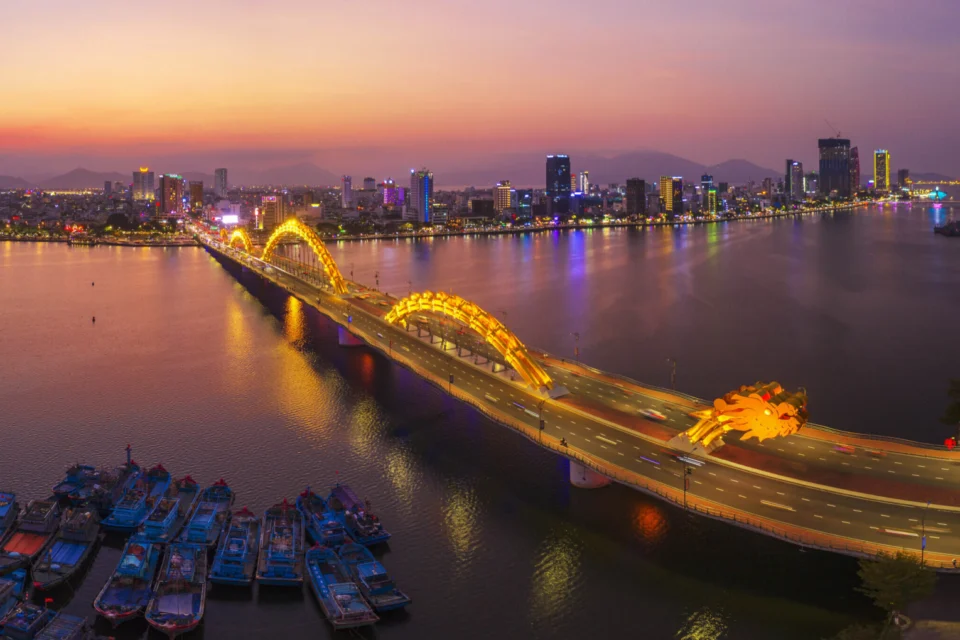
Nicknamed "the city of bridges", Da Nang has shaped its modern identity around the Han river, which separates the historic commercial centre from the seaside districts. Crossing the river is like visiting an open-air gallery of engineering art, where each structure competes in boldness and poetic illumination after dark:
The Dragon Bridge (Cau Rong): 666 metres long, this spectacular bridge is designed as a giant yellow dragon inspired by Nguyen dynasty sculpture, seeming to leap over the water towards the sea.
The Han River Bridge (Cau Song Han): Vietnam's first swing bridge, funded by contributions from the city's residents; its central span pivots 90 degrees in the middle of the night to let cargo ships through.
Tran Thi Ly Bridge: A feat of cable-stayed engineering with a single leaning 145-metre mast, its illuminated rigging evoking a great sailing ship heading out to the ocean.
The Love Bridge and the Carp-Dragon statue: A romantic promenade on the east bank, lined with heart-shaped red lanterns, where couples hang love locks.
Practical tip: The show of the Dragon Bridge breathing fire and water takes place every Friday, Saturday and Sunday at 9 pm sharp (and on major national holidays). Take up position around 8.30 pm along Tran Hung Dao street or on a rooftop café terrace. Beware: if you stand too close to the dragon's head on the bridge during the water jet, you are likely to get soaked!
Address: Banks of the Han river, Bach Dang and Tran Hung Dao boulevards, Da Nang.
6. The Museum of Cham Sculpture: the bewitching mark of a vanished kingdom
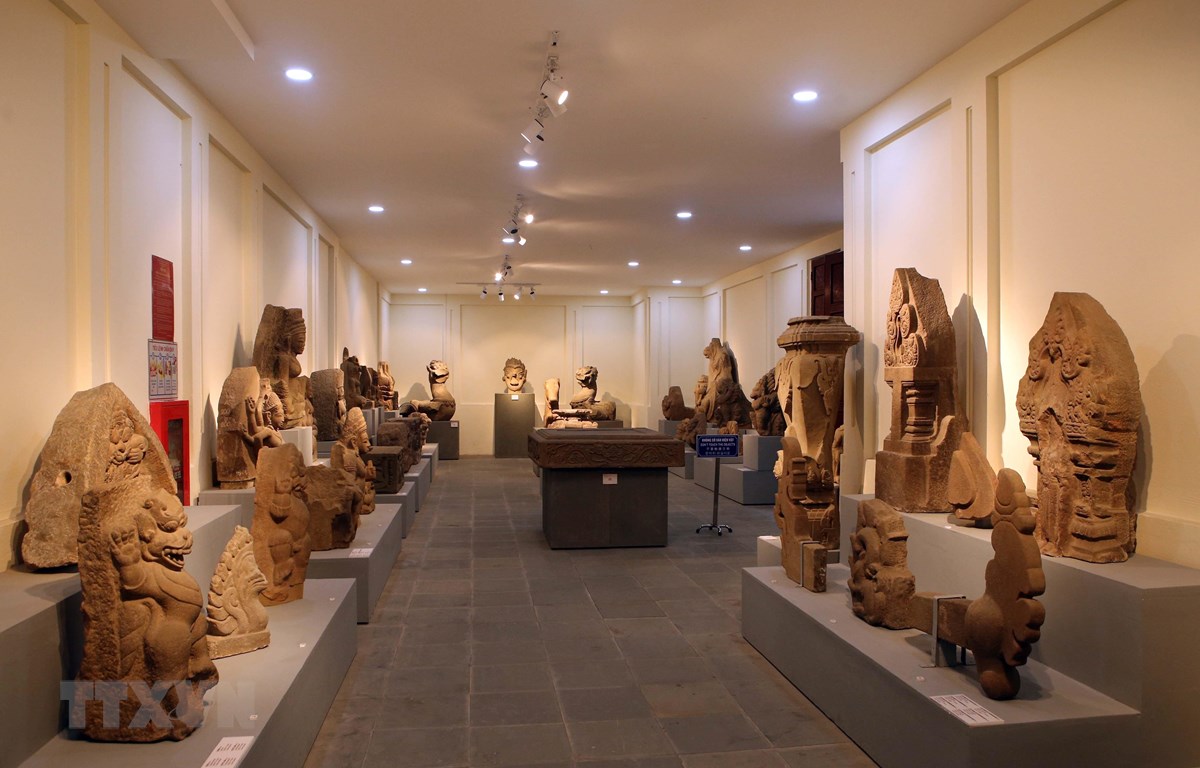
Photo: Tran Le Lam
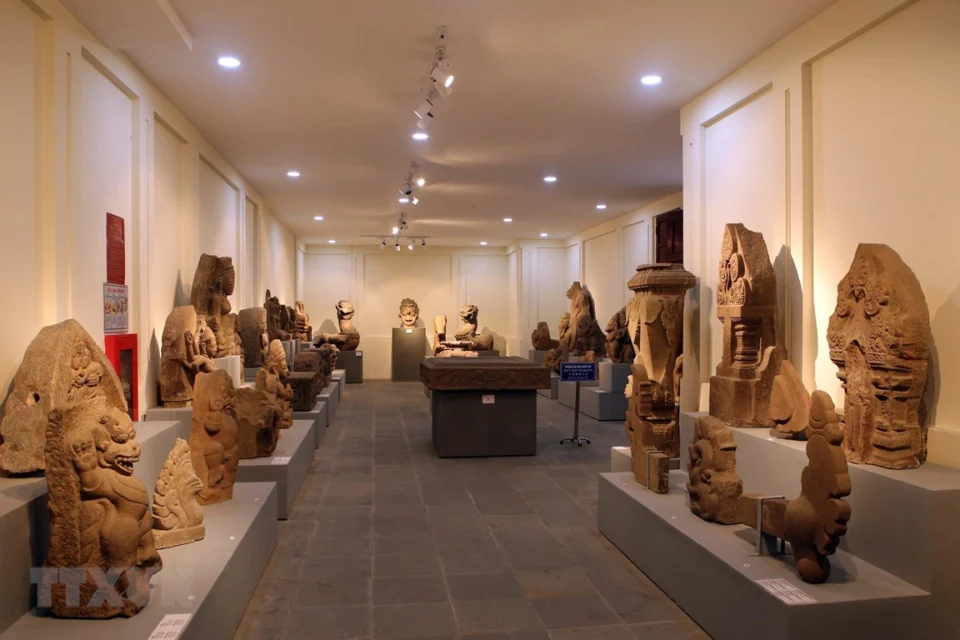
Ideally located in the city centre, at the junction of 2 Thang 9 and Binh Minh boulevards on the bank of the Han river, this museum founded in 1915 by the École française d'Extrême-Orient (EFEO) is a major cultural stop. The building itself, designed by French architects, elegantly combines colonial architecture with decorative elements inspired by the ancient sanctuaries of the Champa civilisation. It holds the largest and most precious collection of Cham sculptures and relics in the world kept in one place.
Through its galleries bathed in natural light, the museum houses more than 300 original works in salmon-pink sandstone, terracotta or bronze, dating from the 7th to the 15th century. Coming from the great archaeological sites of the central region (My Son, Tra Kieu, Dong Duong), these sculptures depict Hindu deities (Brahma, Vishnu, Shiva), legendary creatures (Garuda, Naga), the elephant god Ganesha, sacred altars of extraordinary finesse and voluptuous Apsara dancers, bearing witness to the artistic golden age of the kingdom of Champa.
Practical tip: To fully grasp the historical richness and spiritual value of each work, take the audio guide at reception or scan the QR codes on the labels. Allow about 1.5 to 2 hours for an in-depth, unhurried visit.
Address: No. 02, 2 Thang 9 street, Binh Hien ward, Hai Chau district, Da Nang.
7. The Hai Van Pass (Deo Hai Van): the legendary border between sea and mountain

Deo Hai Van. Photo: Quang Nguyen Vinh
Stretching 21 kilometres along National Road 1A to link Da Nang with Thua Thien Hue province, the Hai Van Pass (Pass of the Clouds) winds along the mountainside through the steep foothills of the Annamite range. Called by former rulers "the most majestic pass under heaven" (Thien ha de nhat hung quan), this legendary road offers one of the most striking coastal panoramas in South-East Asia, attracting travellers in search of thrills and wide open spaces.
Each hairpin bend reveals a grand landscape: on one side, rock walls covered in dense tropical forest; on the other, impressive drops plunging into the blue ocean, with Da Nang bay, Son Tra peninsula and Nam O beach on the horizon. At the top of the pass, at nearly 500 metres, stands the historic site of Hai Van Quan, a brick military gate built under the Nguyen dynasty (recently restored), next to concrete bunkers from the conflicts of the 20th century.
Practical tip: Go up in clear weather in the morning or early afternoon. By scooter or motorbike, take the hairpins with care and sound your horn on blind bends. Absolutely avoid crossing the pass after 5 pm or on rainy days: very dense fog (clouds) settles quickly and reduces visibility to a few metres.
Address: National Road 1A, Hoa Hiep Bac ward, Lien Chieu district, Da Nang.
8. Nui Than Tai hot spring park: an interlude of serenity in the jungle
Nestled in the lush forests of the Ba Na Nui Chua nature reserve, about thirty kilometres west of the city centre, the Nui Than Tai mineral hot spring park is a haven of peace devoted to well-being, relaxation and health. Its special feature is its pure thermal water, which gushes naturally from deep underground at high temperature, rich in minerals that are good for the body, blood circulation and skin.
Designed in a wooden architectural style that blends harmoniously into the mountain landscape, the park offers a very complete range of thermal experiences: real Japanese Onsen baths in lava stone, healing mineral mud baths, pools infused with green tea, coffee or milk serum, and dry and wet saunas. For families, the complex also includes a mountain water park with a wave pool and slides, a life-size dinosaur park for children and the chance to taste the famous "longevity eggs" cooked directly in the natural hot spring pools.
Practical tip: An excellent destination for a full day of relaxation with family or friends, away from the bustle of the coast. Bring swimwear, a towel and light clothing for the day.
Address: Phu Tuc village, Hoa Phu commune, Hoa Vang district, Da Nang.
9. The traditional markets of Con and Han: a tasty, popular immersion

Con market. Photo: Giang Huy
You cannot grasp the soul of Da Nang without immersing yourself in the colourful liveliness of its two most iconic covered markets, part of residents' daily lives for decades:
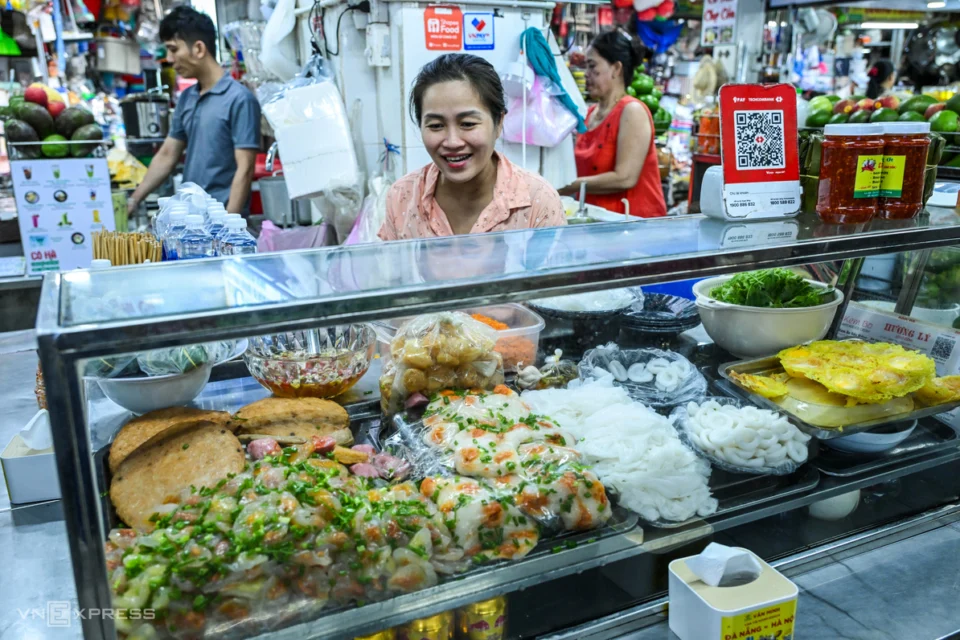
Con market (Cho Con): A true sanctuary of central Vietnam's street food. Inside and out on the forecourts, countless tiny stalls run by local cooks offer a dizzying array of treats: bun mam nem, banh can, nem lui, pha lau, ram cuon la cai and many kinds of sweet desserts (che). It is the ideal place to eat like a local, on small plastic stools, in a warm, spicy and very authentic atmosphere.
Han market (Cho Han): Ideally located on the bank of the Han river, this two-storey market is known for its impeccable organisation and the variety of its local products. It is travellers' favourite place to buy regional delicacies to take home: dried prawns and fish, squid marinated with chilli, quality mam nem, Da Nang chillies, sesame cakes (banh kho kho), or to have a traditional ao dai tailor-made by the seamstresses on the first floor in less than 24 hours.
Practical tip: At Han market, it is customary to bargain with a smile over souvenirs and textiles (a 10% to 20% discount is common). At Con market, head for the indoor food section from 3 pm, when all the small food stalls are open.
Address: Con market (290 Hung Vuong street); Han market (119 Tran Phu street), Hai Chau district, Da Nang.
10. The Hoa Vang countryside and craft villages: the gentle charm of rural heritage
Moving away from the coast westwards into the rural district of Hoa Vang, Da Nang reveals its most bucolic, unspoilt and timeless face. It is a peaceful countryside dotted with green rice fields, bamboo groves, winding streams and old village temples, where the pace of life slows considerably.
The area is home to craft villages with a living memory, such as Cam Ne, renowned since imperial times for hand-weaving rush mats with complex coloured patterns, which once supplied the Nguyen court in Hue. Ecotourism and outdoor enthusiasts will be delighted along the region's rivers and lakes (Yen Retreat, Suoi Mo, Hoa Bac), which offer waterside walks, kayaking, tastings of local farm produce and quiet camping under the stars.
Practical tip: Hire a car with driver or set off for a day trip by bike or scooter along the small country roads of Hoa Vang. It is an ideal alternative for a breath of fresh air and a glimpse of authentic daily life in rural Vietnam.
Address: Hoa Vang rural district, Da Nang (about 15 to 25 km west of the centre).
Culinary specialities of Da Nang: 4 local must-tries
1. Mi Quang
The region's emblematic dish, Mi Quang consists of wide fresh rice noodles served with a little very concentrated, fragrant broth (made with pork, prawns, chicken or river fish). The bowl is topped with quail egg, crushed roasted peanuts, a crispy sesame rice cracker (banh trang) and an assortment of fresh local herbs.
2. Pork rice paper rolls
This roll-your-own dish showcases thin slices of boiled pork belly (cut so as to keep the skin at both ends). The meat is rolled with aromatic herbs, cucumber and green mango in moistened rice paper, then dipped in mam nem, a creamy fermented fish sauce spiced with garlic, chilli and pineapple.
3. Bun cha ca
Da Nang's rice vermicelli soup with fish cakes (Bun cha ca) stands out for its mild, clear broth simmered with squash, pineapple, tomatoes and bamboo shoots. The fresh fish cakes (fried or steamed) are made from local sea fish. A touch of shrimp paste (mam ruoc) and some chilli are added to lift the flavours.
4. Banh xeo and Nem lui
The local Banh xeo is a small, golden and very crispy rice pancake filled with prawns, pork and bean sprouts. Nem lui are skewers of minced pork grilled on lemongrass stalks. Both are rolled in rice paper with raw vegetables and served with a smooth spicy sauce made from pork liver, peanuts and sesame seeds.
Climate and recommended travel periods
Da Nang has a tropical monsoon climate divided into two distinct seasons: the dry season (January to July) and the rainy season (August to December).
The dry season (January to July): the ideal time.
January to April: Mild, pleasant temperatures (20 °C to 28 °C), moderate sunshine and a calm sea. The perfect time for cultural visits, hiking and exploring the region.
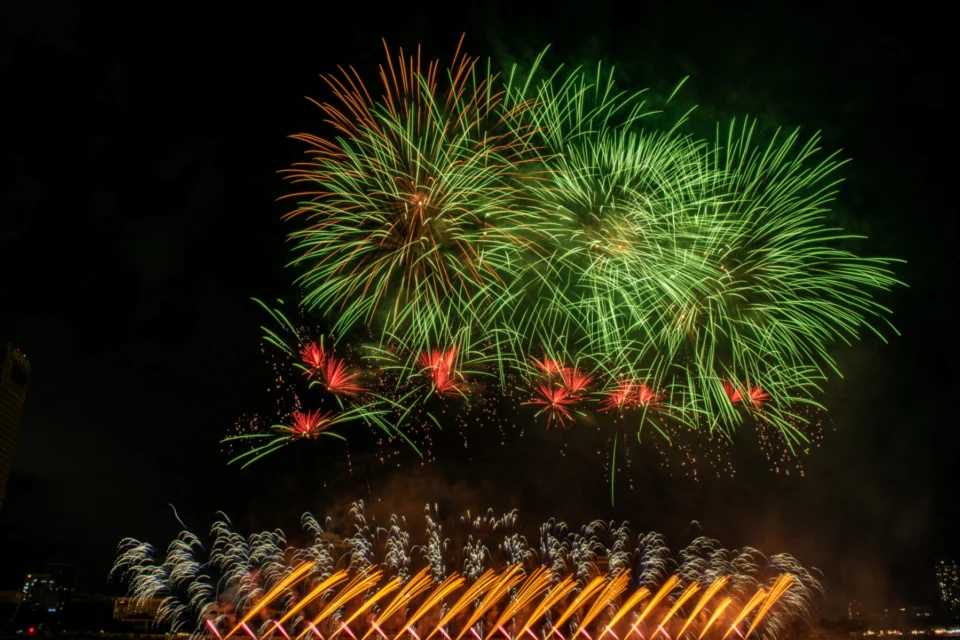
May to July: Hot, sunny season (28 °C to 35 °C), ideal for beach holidays, water sports and summer events such as the Da Nang International Fireworks Festival (DIFF).
The rainy season (August to December): plan ahead.
Marked by more frequent rain and the risk of tropical depressions or typhoons (especially in October and November), which can affect boat trips or mountain excursions. Accommodation and transport prices are, however, more attractive.