More about Top 10 Must-Try Specialities of Ha Giang: Immersed in the Flavours of the Peaks
Ha Giang cuisine: the authentic, rugged flavours of the northern highlands
On the steep limestone peaks of the Dong Van geopark, the cuisine of Ha Giang reflects the harshness of its climate and the creativity of its mountain ethnic groups (Mong, Dao, Tay, Lo Lo). Shaped by the need to withstand the cold at altitude and by the use of local ingredients such as maize, buckwheat and wild herbs, the local food offers bold, smoky and comforting flavours. Here are the ten emblematic specialities you absolutely must taste when you stop in the province.
The must-try specialities of the highlands
Thang Co: the steaming ritual of the great market cauldrons

Thang Co. Photo: Kieu Anh
A fixture of the weekly gatherings in Dong Van, Meo Vac or Sa Phin, thang co single-handedly embodies the conviviality and rustic character of Mong culture. Historically made from horse offal, meat and bones - the horse being the central draught animal of highland life - this traditional stew is now also prepared with beef or black pork. The meat and offal are cut into pieces and browned in their own fat before being simmered for hours in huge cast-iron cauldrons over glowing charcoal. The soul of the dish lies in its complex seasoning: a blend of twelve age-old forest spices, including wild cardamom, cinnamon, star anise, mountain chives and mac khen berries (the slightly lemony wild pepper of the North-West). Served piping hot straight from the cauldron, thang co gives off a very intense woody, spicy aroma. It is traditionally eaten from large shared bowls of wood or plastic, with a small dish of crushed dried chilli to adjust the heat and a sip of local maize spirit to cut through the richness of the broth.
Au Tau porridge: the bitter remedy for mountain nights

Au Tau porridge. Photo: Xuan Phuong
Especially popular in Ha Giang town when the night-time chill sets in, this medicinal rice porridge takes its name and reputation from aconite root (au tau), a tuber that grows on the steepest karst slopes. Used in traditional medicine for its warming, invigorating properties, aconite root contains natural toxins that demand an extremely strict preparation process: it must be soaked in rice water for a whole night, then simmered without interruption for more than twelve hours until its flesh becomes completely harmless and tender. Once mashed, the root is stirred into a rich porridge of fragrant glutinous rice, white rice, slow-cooked pig's trotters and seasoned minced meat. The result is a smooth brown porridge with a unique taste signature: a deep bitterness at first, which quickly gives way to a mellow, woody sweetness on the finish. Served with fresh herbs, hen's eggs and green chilli, it is said to ease joint pain and banish the fatigue built up along the mountain roads.
Buckwheat cake: the golden treat of the autumn harvest
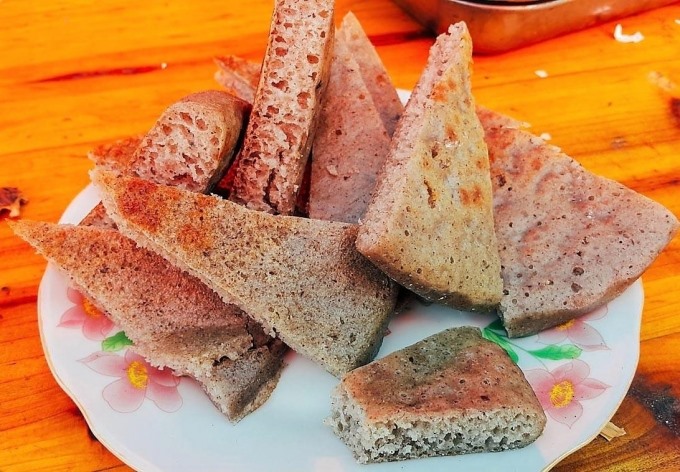
Buckwheat cake. Photo: Focusasiatravel
When late autumn arrives, the famous buckwheat flowers that cover the hills of Ha Giang give way to small dark seeds. Harvested by hand, the seeds are dried in the sun and then ground between heavy traditional millstones into a fine, aromatic flour. To make the cake, the buckwheat flour is mixed with a little water and sometimes maize flour, forming a firm dough that is kneaded and shaped into round cakes about a centimetre thick. The cakes are first steamed in large bamboo baskets to set their soft texture, then placed on charcoal grills in front of the market stalls. As they heat, the outer crust turns lightly golden while the inside stays dense and melting. With a subtle nutty taste and a note of toasted grain, buckwheat cake is eaten hot, plain or dipped straight into the spicy broth of thang co.
Hanging smoked meat: the age-old art of charcoal smoking

Meat smoked above the hearth. Photo: Pao Quan
Born of the historical need to preserve meat through the long winter months without refrigeration, smoking meat hung above the hearth (gac bep) is one of the most emblematic culinary techniques of the Dao, Tay and Mong peoples. Wide strips of buffalo or free-range black pork are carefully selected and marinated for several hours with rock salt, crushed garlic, fresh chilli and mac khen berries. The pieces are then hung from the wooden beams directly above the central hearth of the house, where the wood fire burns constantly for cooking and heating. Over the weeks, the continuous smoke from oak and bamboo slowly dries the meat, giving it an almost black exterior and a natural protective crust. When ready, the meat is cooked in hot ashes, pounded to soften its fibres and shredded by hand. The heart of the meat then reveals a deep ruby red, with a firm chew, a deeply salty flavour and complex resinous, smoky aromas.
Bamboo-tube rice and five-colour sticky rice: celebrating the harvest

Bamboo-tube rice. Photo: Di tich Viet Nam
Symbols of the mountain communities' deep bond with the land and forests, these two sticky-rice dishes hold a special place in both everyday and ceremonial cooking in Ha Giang. Com Lam is the outdoor dish par excellence: highland glutinous rice, first soaked in spring water, is packed into a section of fresh bamboo cut straight from the forest and sealed tightly with banana leaves. The bamboo tube is then set directly on the embers of the campfire and turned regularly until its outer bark is completely charred. The thin inner membrane of the bamboo infuses the rice with a woody, slightly sweet fragrance. For festivals and the New Year, families make the spectacular Xoi Ngu Sac, a five-colour sticky rice representing the five elements of local cosmology (metal, wood, water, fire, earth). The vibrant colours - red, yellow, green, purple and white - are obtained entirely naturally by steeping the rice in infusions of wild leaves, roots, ginger and forest berries, creating a dish as striking to look at as it is fragrant.
Quan Ba maize spirit: the convivial elixir of the limestone plateau
In the heart of Quan Ba district, the village of Thanh Van is famous throughout the North for its craft maize spirit. Unlike the rice spirits of the delta, this elixir is made from yellow maize painstakingly grown in every rocky hollow of the plateau. After the harvest, the maize kernels are boiled for hours and mixed with an exceptional traditional starter made from more than thirty kinds of herbs and medicinal plants gathered deep in the forest. Fermentation takes place slowly in large earthenware jars, buried or kept at room temperature, before artisanal distillation with spring water. The resulting drink, at 25 to 30 per cent alcohol, stands out for its crystal clarity, gentle aroma of toasted maize and smooth roundness that doesn't burn the throat. Pouring a glass of ruou ngo is the Mong's first gesture of hospitality to welcome travellers across their threshold.
Wild mint honey: the liquid gold of the cold season

The beekeeping area lies along the rocky mountainside, where the endemic mint flowers provide ideal foraging for the bees. Photo: Pham Ha
Considered one of the province's most precious and rare specialities, this exceptional honey is produced only in the four districts of the limestone plateau (Dong Van, Meo Vac, Yen Minh and Quan Ba). Between October and December, as the cold sets in, a variety of wild mint with small purple flowers (hoa bac ha) blooms spontaneously across the rock crevices. The local bees gather its nectar to make a honey of unusual colour, ranging from olive green to straw yellow. Its texture is fluid, smooth and velvety, while its taste surprises with delicate floral notes, subtle sweetness and a slightly refreshing aftertaste without being minty like an essential oil. Used in natural medicine to soothe the throat or taken pure with hot tea in the morning, this honey is a much sought-after food souvenir of the region.
Dong Van rolled rice pancakes: the market's gentle morning treat

Rolled rice pancakes. Photo: Xuan Phuong
While banh cuon is a Vietnamese breakfast classic, the version found in the old quarter of Dong Van is perfectly suited to the harsh climate of the high mountains. Unlike the delta version served with diluted fish sauce (nuoc mam), Dong Van banh cuon comes with a bowl of very hot slow-simmered pork broth, infused with fresh coriander and pepper and topped with a slice of meat loaf (cha). The rice batter, spread in a thin layer and steamed on a cloth stretched over a pot of boiling water, is filled with minced pork and wood ear mushrooms before being carefully rolled. The art of eating it is to dip the piping-hot pancake straight into the fragrant broth to warm your hands and stomach before facing the morning mists of the plateau.
Bamboo shoots and mountain greens: nature's fresh bitterness
Highland cooking makes generous use of wild-gathered produce and cold-hardy family vegetable gardens. Mang dang (bitter bamboo shoots), harvested in early spring in the damp forests, has a pronounced but pleasant bitterness. Prepared as a salad with toasted sesame, stir-fried with chilli or simply boiled and dipped in a mac khen wild-pepper sauce, it is said to cleanse the body. It is often served with Rau Cai Meo, a local variety of mustard greens with curly, fleshy leaves. Grown without fertiliser on the rocky slopes, these greens have a crunchy bite, a peppery flavour and a slight hint of bitterness that perfectly balances the richness of the smoked meats and local stews.
Sticky-rice dumplings in ginger syrup: the sweet, comforting finish

Thang Den. Photo: Hoang Giang
To end a meal on a sweet note on winter evenings in Dong Van, Thang Den is the traditional dessert par excellence. Similar to the che troi nuoc of the lowlands but adapted to mountain ingredients, it consists of small hand-rolled balls of glutinous rice, sometimes filled with mung beans or black sesame. The dough balls are poached in boiling water and then dropped into a hot syrup made with brown cane sugar and generous slices of crushed fresh ginger. Served in a small ceramic bowl, thang den is sprinkled with crunchy roasted peanuts and shavings of fresh coconut. The contrast between the soft rice, the crunchy peanuts and the spicy warmth of the ginger syrup makes for a wonderfully comforting treat in the heart of the mountain night.