More about Top 10 Must-Try Specialities of Ben Tre: Treasures of the “Land of Coconuts”
1. Coconut candy: the crown jewel of Mo Cay
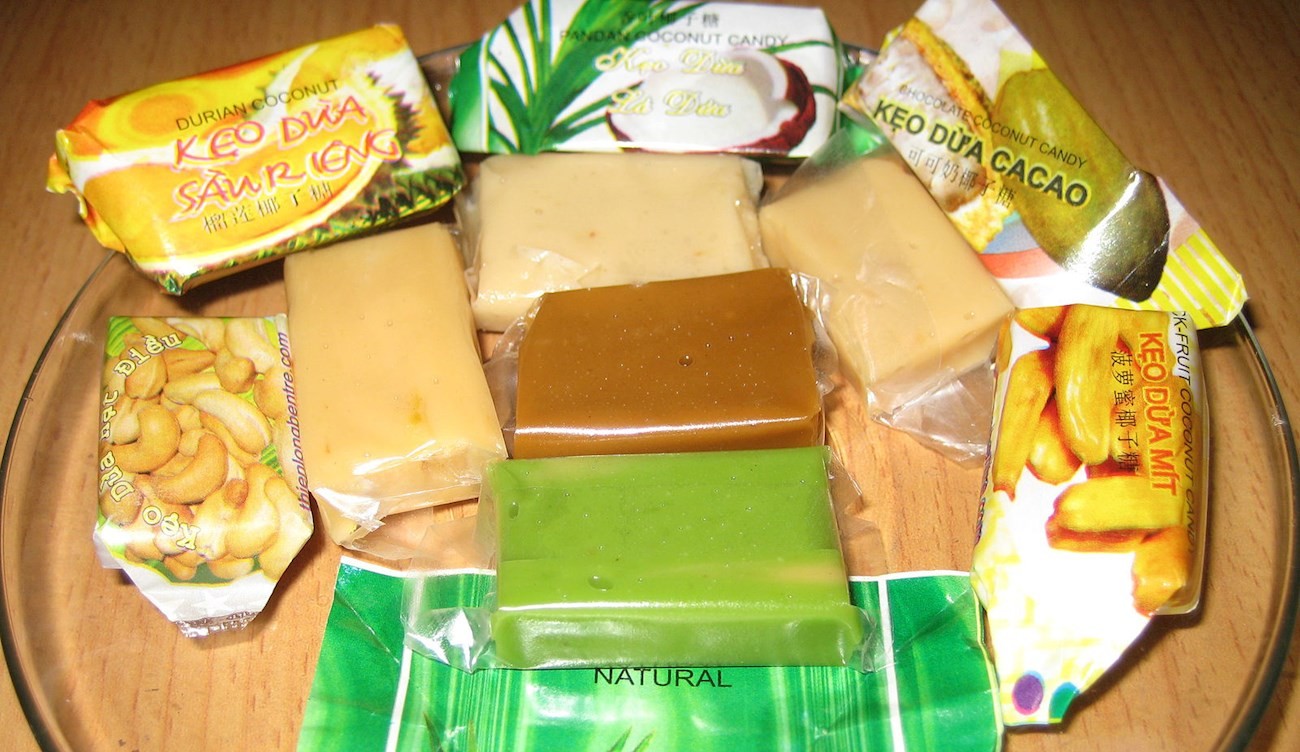
Coconut candy. Photo: Taste Atlas
Considered the province's ultimate culinary ambassador, coconut candy was born in family kitchens in Mo Cay district in the mid-20th century before becoming a national institution. The magic of making it lies in the careful selection of perfectly fresh local ingredients: the flesh of thick mature coconuts is grated and pressed to extract exceptionally dense coconut milk, immediately combined with raw cane sugar and malt from sprouted rice (mach nha). The mixture is poured into huge copper pans heated over a wood fire, where it must be stirred continuously by hand for hours in scorching heat. This precise movement keeps the sugar from burning and lets the water evaporate slowly until the paste becomes supple, amber-coloured and perfectly smooth. Poured into moulds and cut into small rectangular bites, each sweet is wrapped in a thin film of edible rice paper and then in coloured paper. In the mouth, the candy melts slowly, releasing a velvety sweetness, a chewy texture that doesn't stick to the teeth and an unmatched aroma of toasted coconut. Today, Mo Cay's artisans enrich this time-honoured recipe with pure pandan-leaf juice, durian pulp or local cocoa.
2. Coconut palm heart and its variations: the “white treasure” at the heart of the tree
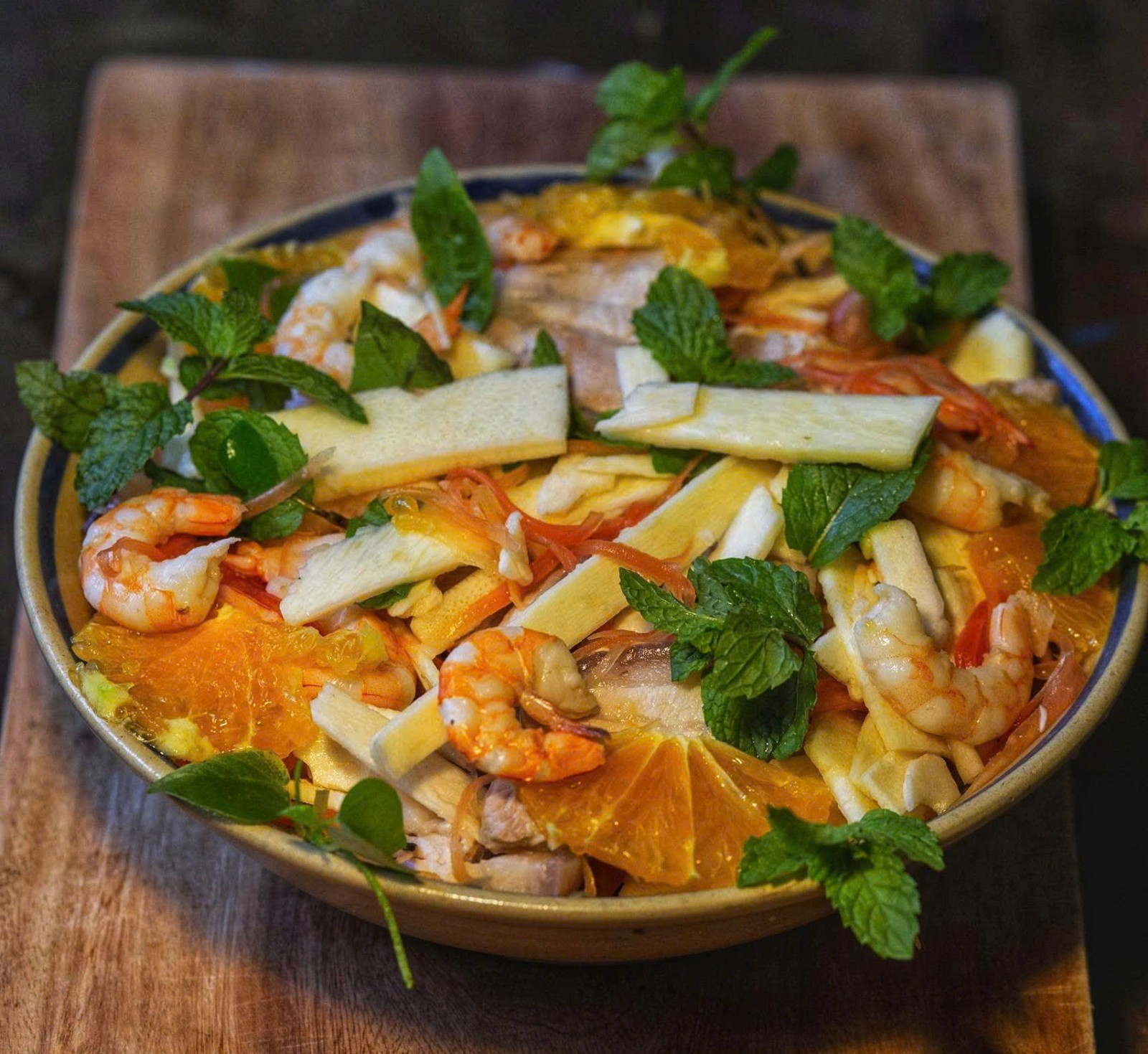
Crunchy coconut palm heart salad with prawns and pork. Photo: Vinh Long Journal
Cu hu dua is the tender bud nestled at the top of the coconut palm's trunk, protected by the first fronds. Because harvesting this precious ingredient means cutting down an adult tree several years old, it is traditionally reserved for big family gatherings or village festivals. Once stripped of its fibrous layers, the heart reveals a dazzling white block, full of water, with a very crunchy texture and a subtly sweet taste reminiscent of fresh hazelnut. Ben Tre's cooks compete in ingenuity to show it off, but its undisputed culinary peak remains goi cu hu dua tom thit (crunchy coconut palm heart salad with prawns and pork). The heart is cut into thin slices or julienne and gently marinated in fresh lime juice. It is then combined with freshwater prawns caught in the river that very morning, sliced poached pork belly, red onions and a handful of aromatic herbs (mint, rau ram). Everything is dressed with a sweet-and-sour nuoc mam infused with garlic and chilli and sprinkled with crushed roasted peanuts. Every bite is a firework of textures, where the juicy crunch of the palm balances the richness of the meat and the freshness of the herbs.
3. Freshwater clam pancake from Snail Island
Nestled on the branches of the Co Chien river, the island of Cu lao Oc (Giong Trom district) has a preserved aquatic ecosystem, ideal for an abundance of small freshwater clams (hen). While the traditional Mekong Delta pancake is filled with minced pork or duck, the Cu lao Oc version offers a unique river-and-garden interpretation. The clams are gathered by hand from the riverbed, washed thoroughly and boiled to extract their tiny, firm, naturally briny flesh. This is quickly stir-fried in a wok with shallots, black pepper and thin strips of coconut palm heart (cu hu dua). The batter, made from rice ground with clear coconut water, a touch of fresh turmeric for its golden colour and a generous ladle of creamy coconut milk, is poured into a scorching pan. The clam and palm-heart filling is added before the pancake is folded into a half-moon. The result is a pancake that is extremely crispy at the edges, with a melting, fragrant filling. To eat it, you cut a piece and roll it in large leaves of wild mustard or tangy mango, before dipping it into a nuoc mam made from reduced clear coconut water.
4. Coconut grubs: the holy grail of adventurous gourmets
At the top of Vietnam's most spectacular culinary experiences, the coconut grub is the offspring of a beetle (bo dua) that lays its eggs at the top of the trees. Once hatched, the larvae bore tunnels into the tender heart of the palm, feeding exclusively on its sweet sap and richest fibres. When they reach the size of a thumb, these plump yellowish grubs are collected by hand. Thanks to their perfectly pure diet, the larvae are extremely rich in protein and have a fatty texture that literally melts in the mouth, releasing an intense flavour reminiscent of fresh cream, melted butter and runny egg yolk. The preparation favoured by connoisseurs is the legendary “duong dua tam nuoc mam”: the live grubs are cleaned in rice spirit and then dropped straight into a small dish of pure nuoc mam with crushed bird's eye chillies. Eating them means overcoming a certain apprehension, but it rewards the gourmet with a striking contrast between the salty, spicy punch of the sauce and the creamy, mellow burst of the grub. For those who prefer them cooked, the grubs are sautéed in butter, pan-fried with salt and chilli, or coated in fine breadcrumbs and deep-fried.
5. Thanh Phu wax coconut: the rare creaminess of the coast

Wax coconut. Photo: Vietnamese Agriculture
Although Tra Vinh is historically associated with this variety of coconut palm, the coastal district of Thanh Phu in Ben Tre has managed to develop its own wax coconut plantations thanks to particularly favourable microclimates and alluvial soils. The wax coconut (dua sap) is a fascinating natural genetic anomaly: only a tiny proportion of the fruit on a single bunch develops this feature. Inside the nut, the water does not stay liquid; it thickens over the months into a syrupy, jelly-like substance, while the flesh becomes remarkably thick, extremely tender, spongy and rich in plant fats. When the nut is opened, instead of the usual firm flesh you find a pulp that can be scooped out with a spoon, with a consistency similar to thick custard or plant butter. The people of Thanh Phu usually enjoy it as sinh to dua sap (wax coconut smoothie): the pulp is blended with crushed ice, a drizzle of sweetened condensed milk and sometimes a few drops of fruit syrup. The resulting drink is pure indulgence, coating the palate with incomparable smoothness and an exceptionally deep coconut flavour.
6. My Long grilled rice cracker: a century of passion and skill

The rice paper village of My Long is more than 100 years old. Photo: Minh Dam.
Made for more than a hundred years in the craft village of My Long (Giong Trom district), this rice cracker is an institution whose fame reaches far beyond the delta. Its superiority rests on a closely guarded recipe: locally harvested white rice, rich in starch, is wet-ground before being generously enriched with freshly pressed coconut milk and toasted white sesame seeds. The batter is ladled into a perfect disc on a cloth stretched over hot steam, then gently laid on bamboo racks to dry in the generous southern sun. When toasted over the embers of coconut wood, the cracker puffs up instantly, crackling in the heat. On the palate, it offers an airy, crumbly crunch, releasing a burst of toasted sesame aromas and the mellow richness of coconut. The artisans make several varieties: the classic sweet version with coconut milk, the savoury version with small dried shrimp, or the thin sheet designed especially for rolling spring rolls.
7. Son Doc puffed rice cake: the crispy cloud of tradition
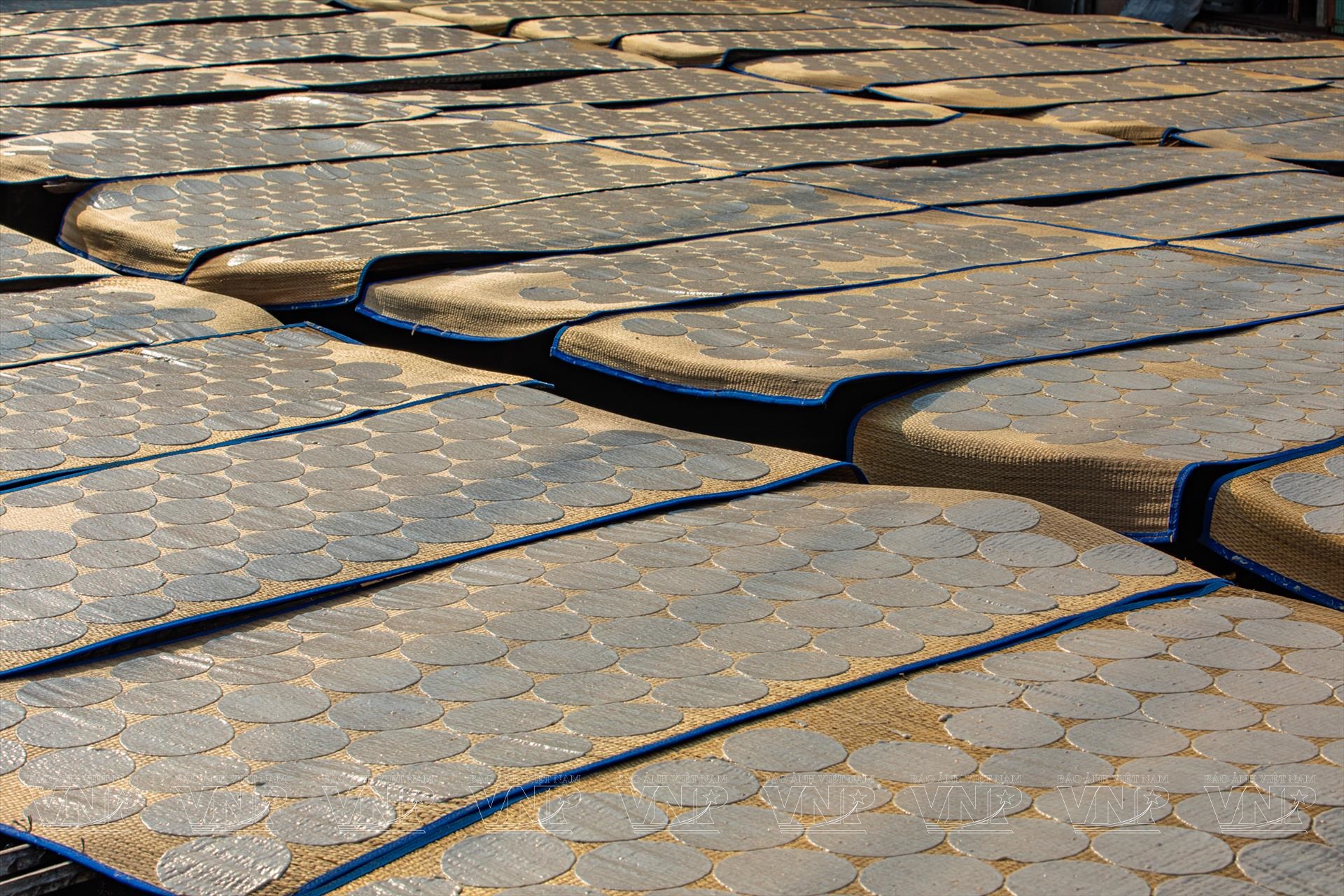
Once cut, the cakes are laid out on woven mats to dry in the sun. Photo: Nguyen Luan
Inseparable from its neighbour My Long, the commune of Son Doc specialises in the complex art of banh phong, a puffed rice cake traditionally made for the Lunar New Year. Making it demands physical strength and endless patience: upland glutinous rice (nep nuong) is steamed and poured, still scalding, into a large stone mortar, where it is pounded relentlessly with thick coconut milk and raw cane sugar until it forms a perfectly elastic dough without a single lump. Shaped into small balls and rolled out into translucently thin discs, the dough is carefully dried. The magic happens when it is cooked over hot ashes: in a few seconds, the small rigid disc transforms into a large golden cake three or four times its size. Almost weightless, banh phong literally melts on the tongue, leaving a delicious trace of toasted rice, creamy coconut and an unforgettable caramel note.
8. Hand-cut noodle soup with duck: country comfort for delta evenings

Rice noodle soup served with orange cakes is a delicious experience for tourists. Photo: Minh Duc
A true monument of Ben Tre's popular cooking, this rustic soup stands out for its artisanal preparation and its silky texture. The term bot xat refers to the cook's precise gesture of rolling out pure rice-flour dough on a wooden board and cutting the noodles by hand with a knife directly over the pot of steaming broth. The topping showcases Muscovy duck (vit xiem), a local breed with firm, lean and deeply flavourful meat. The meat is first sautéed with garlic, shallots and black pepper, then simmered in clear coconut water. As they cook in the broth, the starch released by the fresh noodles naturally thickens the liquid, giving it a velvety consistency and body. The dish is served piping hot in an earthenware bowl, topped with cubes of duck blood steamed with glutinous rice (huyet nep), and always comes with a small dish of nuoc mam with grated ginger and hot chilli to balance the richness of the bird.
9. Rice cooked in a coconut: the height of culinary refinement
Considered one of the most elegant and elaborate dishes in the region, coconut rice turns an ordinary meal into a culinary ceremony. Making it requires extreme care: a medium-sized xiem coconut is selected and neatly trimmed to form a container with its own lid. The coconut water inside is kept, while the hollowed nut serves as a natural “pot”. Fragrant long-grain rice is rinsed directly in the coconut water, then put back into the nut with a precisely measured amount of coconut water. The nut is sealed with its cap and placed in a bain-marie to steam slowly for more than two hours. During this process, the grain literally drinks the fruit's juice while absorbing the essential oils and sweet juices of the inner flesh. When opened, the rice reveals a slightly pearly sheen, perfect softness and a bewitching woody-sweet fragrance. This masterpiece is traditionally eaten with small river prawns (tom dat) cooked in cane sugar and coconut milk until fully caramelised.
10. Flattened banana with coconut milk: the nostalgic street-food treat

Flattened banana with coconut milk - a childhood dessert loved by many people in the Mekong Delta. Photo: Hoang Mai.
A fixture of the street stalls from nightfall in Ben Tre, flattened banana is a modest treat that perfectly illustrates the art of combining simple ingredients into a remarkable taste experience. The recipe calls exclusively for barely ripe chuoi xiem bananas, whose flesh keeps a slight firmness and a hint of natural acidity. The peeled bananas are sliced lengthways and placed on a charcoal grill for a quick first cooking. Once they have cooled slightly, they are slipped into a bag and “flattened” with a sharp blow of a board to break their fibres, before going back on the embers. This second cooking turns the outside golden and crispy while keeping the inside hot and chewy. Served in a deep plate, the grilled bananas are immediately covered with a ladle of warm coconut cream seasoned with a pinch of salt, a touch of sugar and a handful of freshly chopped spring onion. The contrast between the tangy crunch of the banana and the creamy, salty, aromatic coconut topping is simply irresistible.