10 key stops for a stay in Bạc Liêu
1. The house of the Prince of Bạc Liêu - colonial elegance and southern legends

Photo: Khuong Nha
-
Overview and landscape features:
Right in the heart of town, on the banks of the Bạc Liêu river, the residence of the Prince of Bạc Liêu (Nhà Công tử Bạc Liêu) is an architectural gem built in 1919. Designed by a French architect, the house was built with materials entirely imported from France (tiles, woodwork, wrought iron). The building stands out for its elegant neoclassical style, dressed in white and yellow, in the middle of an immaculate garden.
-
Visiting secrets and discovery:
Walking through the drawing rooms and bedrooms takes you into the extravagant daily life of Trần Trinh Huy, a legendary figure of the Delta's golden age. The furniture is priceless: rosewood beds inlaid with mother-of-pearl, rare Chinese porcelain, old gramophones and the region's first car. Local guides passionately tell the extravagant anecdotes of the man who was the South's greatest landowner.
-
Practical tip: Stop at the café in the inner courtyard for an iced tea in the shade of the veranda while admiring the carved details of the facade.
-
Address: 13 Điện Biên Phủ street, Ward 3, Bạc Liêu city, Bạc Liêu province.
2. The Bạc Liêu offshore wind farm - a metal cathedral on the sea

Photo: Phan Thanh Cuong
-
Overview and landscape features:
Built along the coast of Hiệp Thành commune, the Bạc Liêu wind farm (Cánh đồng điện gió) is the first offshore clean energy project in Southeast Asia. The scenery is spectacular: dozens of giant white blades rise above the waves of the East Sea, linked by a long reinforced-concrete walkway winding over the mudflats and mangroves.
-
Visiting secrets and discovery:
Walking out on the walkway above the water feels like walking into the open sea. The contrast between the blue sky, the brown of the marine silt, the dark green of the mangroves and the spotless white of the turbines makes a striking photo setting. At sunset, the blades turn slowly in magical golden light, a modern sight that has become the emblem of the province's renewal.
-
Practical tip: Come in the late afternoon (from 4 pm) to avoid the heat reflected off the sea and capture the sunset behind the turbines.
-
Address: Hiệp Thành commune, Bạc Liêu city, Bạc Liêu province.
3. The Bạc Liêu bird sanctuary - a wild haven in the mangroves
-
Overview and landscape features:
Just 6 km from the city centre, the bird reserve (Sân chim Bạc Liêu) covers more than 100 hectares of primary mangrove forest and wetland. This preserved habitat is home to more than 40 bird species (herons, egrets, cormorants, storks), several of them on the red list of threatened species, living in colonies among the mangroves and reeds.
-
Visiting secrets and discovery:
You explore along wooden boardwalks or in small motorboats gliding quietly along shady canals. Climbing the observation tower gives a view over the canopy: at sunrise or sunset, the sky fills with thousands of birds leaving or returning to their nests in an impressive natural concert.
-
Practical tip: The best time for birdwatching is from May to October, when the birds nest and chicks fill the lower branches.
-
Address: Nhà Mát ward, Bạc Liêu city, Bạc Liêu province.
4. Ghôsitaram pagoda - a masterpiece of Khmer architecture
-
Overview and landscape features:
Located in Vĩnh Lợi district, Ghôsitaram pagoda (Chùa Cù Lao) is considered one of the largest and most beautiful Khmer Theravada Buddhist temples in Southeast Asia. Set in peaceful countryside, it stands out for its bright red and gold colours, its carved spires rising to the sky and its extraordinarily detailed murals.
-
Visiting secrets and discovery:
The main hall (Chánh điện) is a feat of folk craftsmanship: every pillar, roof and cornice is decorated with reliefs of mythological creatures (Naga, Garuda, Apsara) and scenes from the life of the Buddha. Visitors can stroll under the cool colonnades, watch the artist monks restoring the gilding and soak up the soothing spiritual atmosphere.
-
Practical tip: Wear covering clothes (shoulders and knees covered) out of respect, and take off your shoes before entering the sacred hall.
-
Address: Cù Lao hamlet, Hưng Hội commune, Vĩnh Lợi district, Bạc Liêu province.
5. The century-old longan orchards of Giồng Nhãn - the freshness of the coastal strip
-
Overview and landscape features:
Running along the coast of Hiệp Thành and Vĩnh Trạch Đông communes for more than 11 kilometres, the Giồng Nhãn area has century-old longan orchards planted on alluvial sand ridges (giồng cát). The trees, with mossy, twisted trunks, spread their gnarled branches to form cool green tunnels over the village lanes.
-
Visiting secrets and discovery:
A trip to Giồng Nhãn is a welcome country break. Visitors can cycle under the canopy and stop at family farms to pick and taste the famous local varieties (nhãn da bò, nhãn xuồng cơm vàng) with firm, juicy and very fragrant flesh. It is also a chance to rest in hammocks strung between the trees while tasting longan products such as longan blossom honey.
-
Practical tip: Plan your visit for August or September, in the full harvest season, to see the bunches of fruit turning golden in the sun.
-
Address: Giồng Nhãn coastal road, Bạc Liêu city, Bạc Liêu province.
6. The salt fields of Hòa Bình and Đông Hải - the white mirrors of the South

Photo: VOV Du Lich
-
Overview and landscape features:
Stretching as far as the eye can see along the coast of Hòa Bình and Đông Hải districts, the Bạc Liêu salt fields (Cánh đồng muối) form a fascinating geometric landscape. Divided into large regular squares crossed by seawater, these pans turn the coast into a mosaic of giant mirrors reflecting the light of the sky.
-
Visiting secrets and discovery:
A visit early in the morning or late in the afternoon lets you watch the hard yet poetic work of the local salt workers. With wooden rakes, they gather the salt crystallised by evaporation into gleaming white pyramids lined up as far as the eye can see. The site offers photos of rare purity, capturing the contrast between dark earth, white salt and the warm colours of sunset.
-
Practical tip: The salt harvest takes place in the dry season, from December to April. Wear sunglasses to protect yourself from the glare.
-
Address: Hòa Bình and Đông Hải districts, Bạc Liêu province.
7. The Đờn ca tài tử and Cao Văn Lầu memorial - the cradle of the southern soul

Photo: VnExpress
-
Overview and landscape features:
Located in Bạc Liêu city, this large cultural complex is devoted to the art of Đờn ca tài tử (UNESCO intangible heritage) and to the composer Cao Văn Lầu, author of the masterpiece Dạ cổ hoài lang. The memorial's architecture is striking, with buildings shaped like giant conical hats (nón lá) rising from lotus ponds.
-
Visiting secrets and discovery:
The museum traces the history and development of southern Vietnamese traditional music through collections of old instruments (zithers, lutes, two-string fiddles), original scores and portraits of great masters. The visit often ends with an intimate concert by local artists performing nostalgic pieces on traditional instruments.
-
Practical tip: Ask at reception for the times of live singing performances to combine a cultural visit with music.
-
Address: Ward 2, Bạc Liêu city, Bạc Liêu province.
8. Quan Âm Phật Đài (Mẹ Nam Hải) - the sanctuary that protects seafarers

Photo: Congly
-
Overview and landscape features:
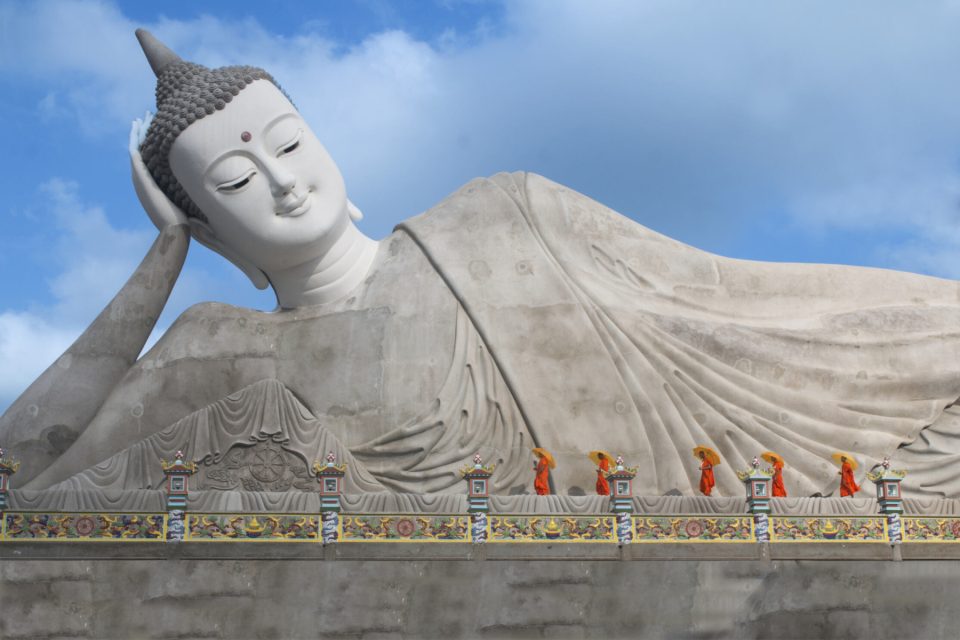
Facing the sea in Nhà Mát ward, the Quan Âm Phật Đài sanctuary is one of the most famous Buddhist pilgrimage sites in southern Vietnam. It is dominated by a monumental 33-metre statue of the goddess Guanyin (Mẹ Nam Hải), erected in 1973 on the sea dyke, her kindly gaze turned towards the open sea.
-
Visiting secrets and discovery:
The spiritual heart of the fishing community, the site welcomes thousands of worshippers every day who come to pray for safe crossings and good catches. You wander among large outdoor altars decorated with carved dragons, listening to the crash of the waves and the temple bells. The esplanade enjoys a constant sea breeze and an exceptional view of the ocean and the colourful trawler fleet.
-
Practical tip: Go early in the morning to see the fishermen's prayer ceremonies before they set out to sea.
-
Address: Nhà Mát ward, Bạc Liêu city, Bạc Liêu province.
9. Xá Lợi temple and its great stupa - Buddhist serenity by the water
-
Overview and landscape features:
Located in Vĩnh Lợi district, Xá Lợi temple (Chùa Xá Lợi) stands in a large landscaped park lined with calm canals. The sanctuary is famous for its majestic nine-storey stupa tower in traditional Mahayana style, whose golden silhouette dominates the surrounding plain.
-
Visiting secrets and discovery:
The temple is a place of contemplation and total peace. Visitors can climb the floors of the stupa to see Buddhist relics and finely carved bronze statues, enjoying at each level an open view over green rice fields and the coconut palms of the countryside. The outer gardens, with bonsai and stone bridges, invite a contemplative stroll.
-
Practical tip: It is an ideal peaceful stop on the road between Sóc Trăng and Bạc Liêu.
-
Address: Hưng Hội commune, Vĩnh Lợi district, Bạc Liêu province.
10. Bạc Liêu central market and the canal quays - the bustle of river life
-
Overview and landscape features:
Set along the Bạc Liêu river in the heart of town, the central market (Chợ Bạc Liêu) is the province's economic and popular lung. Around its covered hall spreads a maze of colourful stalls and quays where boats and fishing vessels constantly unload produce from sea and land.
-
Visiting secrets and discovery:
Wandering the aisles is a festival of colours, smells and flavours. There are huge stalls of fresh brackish-water fish, mangrove crabs tied with raffia, wild shrimp and mountains of tropical fruit and spices. It is the perfect place to try local street food (spicy beef noodle soup, crispy pancakes) and experience the legendary hospitality of southerners.
-
Practical tip: Visit the market from 6 am to catch the bustle of the catch being unloaded and enjoy the best breakfast stalls.
-
Address: Trần Phú street, Ward 3, Bạc Liêu city, Bạc Liêu province.
Bạc Liêu specialities: 4 local dishes not to miss
-
Bạc Liêu spicy beef noodle soup (bún bò cay): The unmissable noodle soup with tender beef in a broth of horn chilli and satay, an explosion of hot, spicy flavours unique in Vietnam.
-
Bánh xèo Giồng Nhãn: A giant pancake with thin batter infused with coconut milk and turmeric, cooked golden over a wood fire and filled with wild brackish-water shrimp.
-
Bún nước lèo: A noodle soup with snakehead fish and roast pork, lifted by a clear broth scented with Khmer fermented fish paste and galangal.
-
Bánh tằm bì: Thick handmade rice-starch noodles topped with a daring combination of creamy coconut milk and sweet-and-spicy fish sauce.
Climate and best times to travel
Bạc Liêu province has a hot, steady tropical monsoon climate all year round, with an average annual temperature of about 26 °C to 28 °C and two distinct seasons:
-
The dry season (December to April): the ideal time for cultural and coastal discoveries
-
December to February: Very pleasant, dry weather cooled by sea breezes (22 °C to 30 °C). The ideal time to explore the salt fields at harvest, visit the historic residences and tour the wind farms.
-
March to April: Hotter and very sunny (temperatures can reach 34 °C). Ideal for coastal outings at Nhà Mát and shady walks in the Giồng Nhãn orchards.
-
-
The rainy season (May to November): the season of plentiful seafood and fruit
-
Showers are usually short, heavy tropical downpours in the late afternoon. This is the best time for birdwatching in the reserve and for eating ripe longans at Giồng Nhãn (mainly from August to October).
-