More about Dong Thap

Photo: VNA
1. Lotus Leaf Pagoda (Phuoc Kien temple)

(Photo: Quynh Tran)
In Chau Thanh district, Phuoc Kien temple is a fascinating attraction thanks to its ponds full of giant lotus leaves, each 2 to 3 metres in diameter. Visitors can step onto the leaves and stand or sit on them for photos. The leaves can support up to 140 kg.
Access to the lotus ponds is free. However, to sit on the leaves for photos, a service places wooden boards on them for 30,000 VND per session. Note that along the way many houses display « Parking for the temple » signs and offer motorbike taxis to take you there. If you come by car, park near the bridge; by motorbike, you can cross the bridge to the temple. The pond in front of the temple is small; visitors can walk round to the right to reach a larger pond full of lotuses.
2. Tram Chim National Park

(Photo: Ngo Tran Hai An)
In Tam Nong district, Tram Chim National Park is home to more than 230 bird species, including 32 rare species and 16 on the Red List. In 2012, Tram Chim became the world's 2,000th Ramsar site (wetland of international importance) and Vietnam's fourth. It is also a conservation area for the sarus crane.
See also: The Tram Chim ecosystem: a practical guide to the last wild grassland of the Mekong Delta

(Photo: Kha Han)
February is the best time to visit Tram Chim and see migratory birds. Visitors can travel by motorboat or towed boat. Two routes are offered, 12 km and 21 km long, taking 1 hour 30 and 3 hours. Along the way, visitors can admire a miniature landscape of the Dong Thap Muoi region, with melaleuca forests, sedge fields, wild rice and lotus fields. During the flood season, from August to November, Tram Chim offers trips combining fishing, net casting, trap setting and field-rat hunting.
3. Huynh Thuy Le old house

(Photo: Dong Phong)
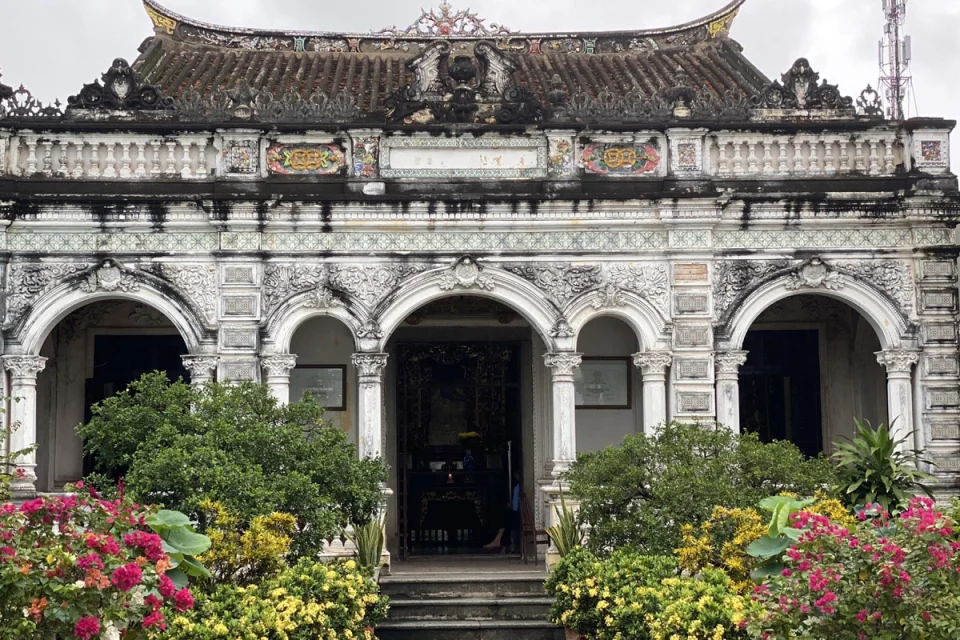
Right in the heart of Sa Dec city, on Nguyen Hue street, the Huynh Thuy Le old house is smaller than the Binh Thuy old house in Can Tho. This traditional three-bay house, typical of south-western Vietnam, covers about 250 square metres. Built mainly of precious wood, it has a boat-shaped roof covered with yin-yang tiles. Almost entirely intact, it offers many photo opportunities.
Besides its blend of Eastern and Western architecture, the house is famous for its link to a cross-border love story between a young Frenchwoman and a wealthy Vietnamese man of Chinese origin, the owner, in the early 20th century. The story inspired the novel « The Lover », later adapted for the cinema and filmed in this very house.
4. Kien An Cung pagoda
Also known as Ong Quach pagoda, this century-old pagoda shows a remarkable Chinese architectural style. It has three parts: the east wing, the west wing and the main hall. Its roof has three layers: tiles on top, bricks in the middle and tiles below. The tiles are laid in a wave pattern evoking the five elements. Each wave represents a miniature palace, six palaces in all. The pagoda has no rafters, only purlins joined by mortise and tenon. The walls are decorated with scenes from Journey to the West and Romance of the Three Kingdoms. Listed as a national historic monument in 1990, the pagoda is open daily from 6 am to 6 pm, with free entry.
5. Xeo Quyt tourist site

(Photo: Kha Han)
The Xeo Quyt historic site is an important destination. From 1960 to 1975, the Kien Phong (now Dong Thap) Provincial Party Committee set up its base here during the war of resistance against the United States. 30 km from Cao Lanh, Xeo Quyt is easy to reach from Cao Lanh and Sa Dec. It covers about 50 hectares, including 20 hectares of pristine melaleuca forest.
The Xeo Quyt historic and ecological site offers visitors total immersion in primary forest, in the heart of wild, preserved nature. Xeo Quyt can be reached by road or by water.
If you like to wander beneath the canopy, you can take the site's single trail, about 1.5 km long. Listed as a national historic site in 1992, Xeo Quyt is a historic destination preserving traces of the struggles of the people and army of Dong Thap.
6. Dong Sen Thap Muoi ecotourism area
(Photo: Nhut Minh)
This is where visitors can see the greatest concentration of lotuses in Dong Thap. The best time is from June to November. If you cannot come during full bloom, you can still visit at any time, as the air is fresh and peaceful.
Here you can watch the lotuses' spectacular change of colour. Usually pale pink in the morning, they turn pink by noon. Around 3 pm the lotuses are considered at their most beautiful, when the flowers are fully open and their black and yellow seed heads sparkle in the sun. Later in the afternoon the flowers gradually turn deep pink, and at sunset they glow bright red like the setting sun.
Opening hours: 7 am to 5 pm daily. Entry: 20,000 VND on weekdays and 30,000 VND at weekends.
7. Lai Vung pink mandarin orchards
Lai Vung, about 10 km from Sa Dec, lies between the Tien and Hau rivers. Thanks to plentiful fresh water and fertile alluvial soil, the area has become a thriving fruit-growing zone. The Lai Vung pink mandarin orchards are especially famous and attract many tourists.
The pink mandarin season is usually at the start of the year. The period from ripening to harvest lasts about a month and a half, around the Lunar New Year. This is also when the orchards open to visitors and fruit sales begin. Visitors can stroll, take photos, pick fruit and buy some to take away. Around March-April, the mandarin orchards are covered in white blossom with a delicate scent recalling pomelo, orange and lemon flowers.
8. Dinh Yen mat-weaving village
On the bank of the Hau river, about 15 km from Cao Lanh city, the Dinh Yen mat-weaving village was founded several centuries ago. On arrival, visitors are charmed by the lively atmosphere. Houses and lanes are full of colour, with green, red, yellow, white and purple sedge fibres, and laughter and chatter echo through the streets.
Dinh Yen mats include plain white mats, mats printed with floral patterns and cranes, and richly decorated wedding mats. In Dinh Yen there are no fixed stalls; buyers usually wait in one spot while vendors come to offer their mats. In the past the market ran late into the night, until 2 or 3 am, hence its nickname « ghost market » or « underworld market ». In 2013, the mat-weaving craft of Dinh Yen commune was recognised as national intangible cultural heritage.
9. Temple of the Cao Lanh market founders
On Le Loi street in Cao Lanh, the temple dedicated to the founders of Cao Lanh market (Mr and Mrs Do Cong Tuong) is renowned throughout the region for its sacredness, especially among traders. Over the centuries and many restorations, the site has become a complex of temple, guesthouse and tomb, built of sturdy materials and decorated with carvings in the Nguyen-dynasty style typical of late-19th-century temples and shrines in southern Vietnam. Together with the shrine of the Lady of Sam Mountain, it is a popular spiritual destination, drawing many visitors at festival times.
10. Sa Dec flower village

(Photo: Ngoc Tai)
Considered a true kingdom of flowers, Sa Dec flower village was established in the late 19th century along the Tien river and covers nearly 800 hectares. First concentrated in Tan Quy Dong ward, flower growing has now spread to two other wards, with more than 2,300 households taking part. The village grows about 2,000 varieties of ornamental plants, from flowering plants and foliage plants to landscaping plants and fruit trees.
Source: Tam Anh/VnExpress