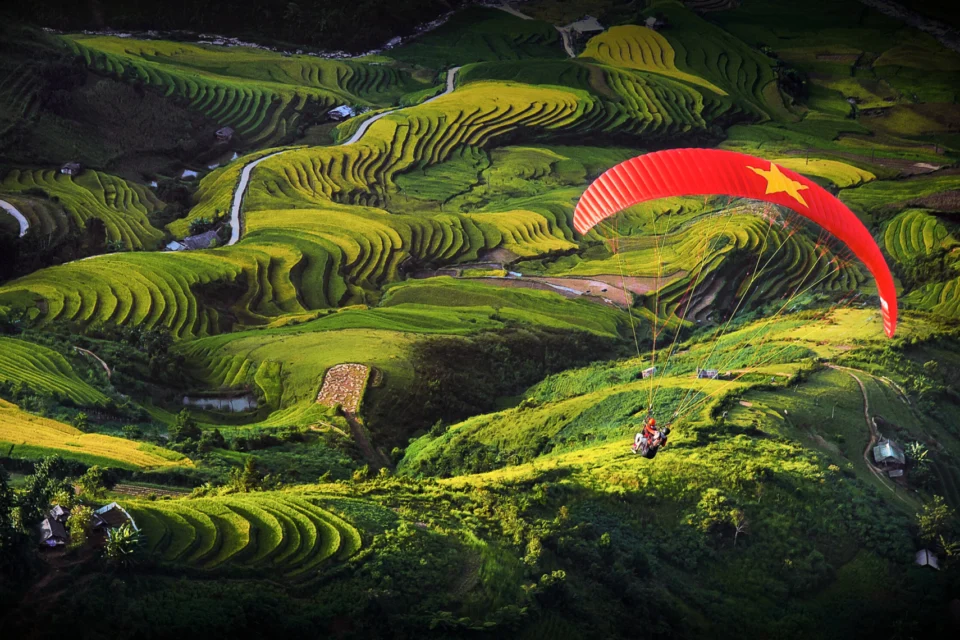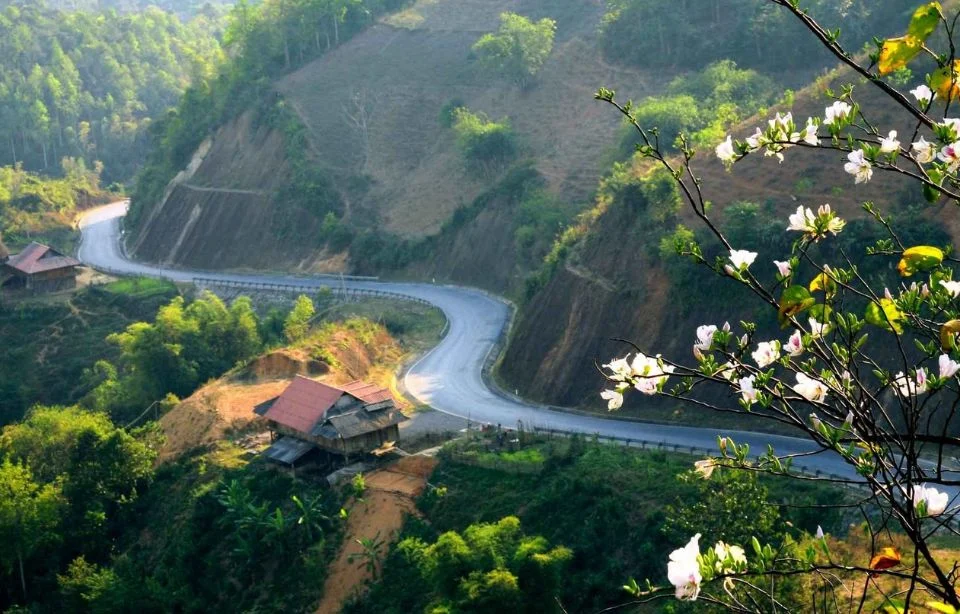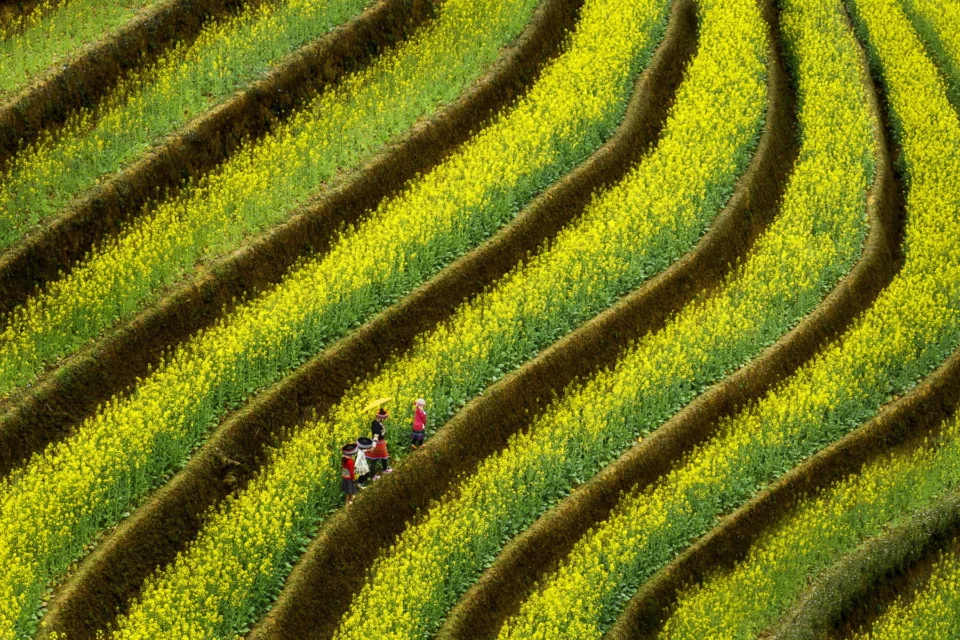
More about Son La

Wild hawthorn (son tra) in bloom in Son La. Photo: Meo Già
Getting there
From Hanoi and the northern provinces, reach Son La by road via National Route 6, National Route 37 or CT05 (Noi Bai - Lao Cai expressway), then National Route 37. The journey takes about 6 hours 30 minutes. Besides private cars, visitors can take buses and sleeper or seated limousines from My Dinh or Yen Nghia bus stations, with tickets from 150,000 to 350,000 VND.
Son La has no airport. The nearest is Dien Bien airport, nearly 170 km from central Son La. The drive from Dien Bien airport to Son La takes about 3 hours.
1. Moc Chau plateau
See also: Visiting the Moc Chau plateau: between tea crops, karst landscapes and mountain traditions

Green meadow near the mountains. Photo: Beast Creations
Moc Chau is one of the most famous destinations in the North, with pure natural beauty and a different character each season.
Arriving in Moc Chau at the start of the year, you will see apricot, plum and peach blossoms in full bloom. This highland area is also a place for picking fruit such as persimmons, strawberries, apricots, plums and peaches. Wild sunflowers bloom brightly around October, before the mustard flower season. Moc Chau also has vast tea hills, the pine forests of Ban Ang, Dai Yem waterfall, Chieng Khoa and Nang Tien. For visitors who like exercise and want to visit Nguyen Thuy village, Pha Luong peak is the right choice.
2. Son La prison relic site

Son La prison relic site. Photo: Bao Son La
Son La prison stands on Khau Ca hill in To Hieu ward, Son La city, and was listed as a special national historic site on 31 December 2014. Adults and children over one metre tall buy an entry ticket for 30,000 VND.
The prison was built by the French colonialists in 1908 with an initial area of 500 m2. After three extensions, it grew to 2,170 m2, including a row of cells 3 m underground, 5 individual cells and 2 collective cells. The building is solidly built; the prisoners' beds are stone with cement surfaces, with a system of leg shackles along the entire floor. The place was likened to « an open coffin, waiting for the prisoner to die and be buried ». From 1930 to 1945, the French colonialists exiled 14 groups of political prisoners here, 1,013 people in all, including famous prisoners such as To Hieu, Le Duan, Truong Chinh, Nguyen Luong Bang, Van Tien Dung, Le Duc Tho, Le Thanh Nghi and Tran Quoc Hoan.
3. Ban Mong mineral spring
Ban Mong is an ecotourism, cultural and resort destination about 5 km from central Son La. The road to the village winds along the hillside and is mostly paved, making it easy to travel. Visitors can admire beautiful natural scenery and breathe fresh, airy air. The water temperature is always stable between 36 and 38 degrees Celsius, with no odour, so visitors can bathe at any time of year.
The mineral springs are open from 8 am to 6 pm daily. Tickets for herbal-leaf and hot mineral baths cost 120,000 VND per person.
4. Son La hydroelectric reservoir

Son La hydroelectric reservoir. Photo: Bao Son La
The Son La hydroelectric plant was built on the Da river and inaugurated in 2012. It created a large lake more than 150 km long and covering about 16,000 hectares, which has become a tourist destination. Taking a boat on the lake, visitors can relax and admire the wild, mysterious beauty of the river. On both shores are the stilt houses of resettled families. Visit the market along the Da river, admire Pa Uon bridge, join the traditional boat race festival on the 10th day of the first lunar month each year and taste river fish dishes prepared in the unique Thai way.
In Muong La district, near the Son La hydroelectric plant, visitors can also visit Ngoc Chien commune, home to three ethnic groups, the Thai, Mong and La Ha, with a diverse and hospitable culture.
5. Ta Xua, paradise of clouds
Ta Xua, at more than 2,800 m, is one of Vietnam's highest peaks, in Bac Yen district, bordering Tram Tau district (Yen Bai). Ta Xua is 240 km from Hanoi, has a cool climate all year round and is famous as a magnificent cloud-hunting spot from October to April. Its terrain consists of narrow, steep roads with deep chasms on both sides. Besides going by motorbike or car, you can trek to the summit of Ta Xua, with routes of different lengths from Son La and Yen Bai.
6. Wild hawthorn flower forest

Plum blossom forest. Photo: Hai Duong
Ngoc Chien commune, Muong La district, at an average altitude of 1,800 m, has set the record of « commune with the largest wild hawthorn (son tra) flower forest in Vietnam ».
Holder of a Vietnamese record, at the end of 2023 Ngoc Chien commune had more than 2,500 hectares of hawthorn, of which more than 1,400 hectares were flowering and fruiting. Every March the hawthorn blossoms white, creating a romantic scene that draws visitors. Ngoc Chien also has hot mineral springs averaging 37 to 40 degrees Celsius, a special tourist attraction.
7. Phu Yen district
Phu Yen is a mountainous district in the east of Son La, centred on the Muong Tac field, considered the third largest field in the North-West. In Phu Yen there are several places worth visiting, such as General Vo Nguyen Giap's forest, a historic relic of the resistance war against the French, now managed by the local authorities as a protective forest of nearly 197 hectares. There is also the 1,300-hectare Noong Cop pine forest with thousands of pines over 30 years old, a green lung attracting visitors who love to return to nature.
8. Pha Din pass and its flower valley
Ranked among the legendary « four great passes » of northern Vietnam alongside Ma Pi Leng, O Quy Ho and Khau Pha, Pha Din pass stretches 32 km on the border between Son La and Dien Bien provinces. Rising above 1,000 metres, the road winds along the mountainside through grand landscapes, with hairpin bends overlooking valleys lost in mist. At the top, visitors can stop at the Pha Din Pass ecotourism area, with large multicoloured flower gardens, panoramic viewpoints and rest areas offering spectacular views of the surrounding ranges.
For road-trip and photography lovers, the pass is especially pleasant in the dry season (October to April), when visibility is ideal and the sky is clear. Allow about 3 to 4 hours by road from central Son La via National Route 6. Drive carefully, especially in the late afternoon or early morning, as frequent fog can reduce visibility. On site you will find small stalls selling local specialities such as grilled corn, dried buffalo meat and mountain tea.
9. Chieng Khoa waterfall
In Van Ho district (right next to Moc Chau), Chieng Khoa waterfall, formerly called May waterfall, is a preserved natural gem of 7 tiers of water tumbling through lush forest. Nicknamed by travellers the « tuyet tinh coc » (secret valley) of Son La, it charms at once with the sparkling turquoise of its natural pools and the complete calm of the site. The still water at the foot of the main falls lets you cool off or take a bamboo raft close to the cascades.
The site is open daily and entry costs about 20,000 to 30,000 VND per person, with rafts and life jackets for hire. To enjoy the emerald colour of the water, visit between October and April, as the water can become murkier during the heavy summer rains. Wear non-slip shoes for the wet rocks around the pools and keep the site clean by taking your rubbish with you.
10. Son Moc Huong cave (Bat Cave)
Right in the heart of Moc Chau district, a few hundred metres from National Route 6, Son Moc Huong cave (Hang Doi) is listed as a national scenic site. Nicknamed the « first cave of the Moc Chau plateau », this huge cave system of more than 7,000 m² holds spectacular stalagmites and stalactites shaped by water over millennia. Inside are rock formations evoking fairy-tale shapes, legendary animals and majestic domes lit with artistic lighting.
The cave is reached by climbing 240 stone steps winding through greenery, a good workout rewarded by the natural coolness of the cave. Entry is very affordable (about 20,000 VND) and a visit usually takes 1 to 1.5 hours. It is an ideal cultural and geological stop to combine with a day exploring Moc Chau's tea hills and orchards.
Source: Tam Anh/VnExpress