
To date, Vietnam has 15 elements of intangible cultural heritage recognised by UNESCO. Vietnam is one of the most attractive countries in the world, not only for its magnificent landscapes but also for its vast and unique cultural treasure. Join VNCT in this article to explore which intangible cultural heritage elements they are!
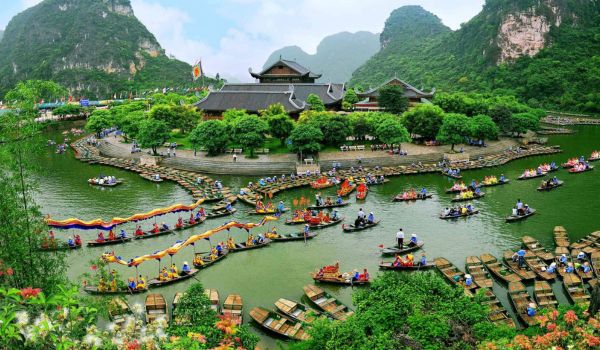
Vietnam currently has 15 intangible cultural heritage elements recognised by UNESCO
Nha Nhac Cung Dinh Hue - Vietnamese court music
Among Vietnam’s UNESCO intangible cultural heritage elements, Hue royal court music was the first. Nha Nhac, meaning “elegant music”, encompasses a variety of musical styles and dances performed at the Vietnamese royal court from the 15th to the mid-20th century.
At the time, Nha Nhac was an essential part of ceremonies linked to birthdays, religious festivals, coronations, funerals and official receptions. Of the many musical genres developed in Vietnam, only Nha Nhac can claim national scope and close links with the traditions of other East Asian countries.

Nha Nhac
Nha Nhac performances featured numerous singers, dancers and musicians in sumptuous costumes. The large orchestras included an imposing drum section and various types of percussion instruments, as well as a variety of wind and string instruments.
Each performer had to maintain a high level of concentration to follow every step of the ritual meticulously. First developed under the Le dynasty (1427-1788), Nha Nhac was fully institutionalised and codified under the Nguyen monarchs (1802-1945).
A symbol of the dynasty’s power and longevity, Nha Nhac became an essential element of court ceremonies. Its role, however, went beyond accompanying rituals, as it also served as a means of communication, of paying homage to gods and kings, and of passing on knowledge.
In 2003, Nha Nhac was recognised by UNESCO as an intangible cultural heritage of Vietnam.
The Space of Gong Culture
In 2008, the second of Vietnam’s intangible cultural heritage elements recognised by UNESCO was the space of gong culture. This tradition of the Central Highlands is closely linked to the daily life of the local people. Their belief systems form a mystical world in which gongs provide a special language between humans, deities and the supernatural world.
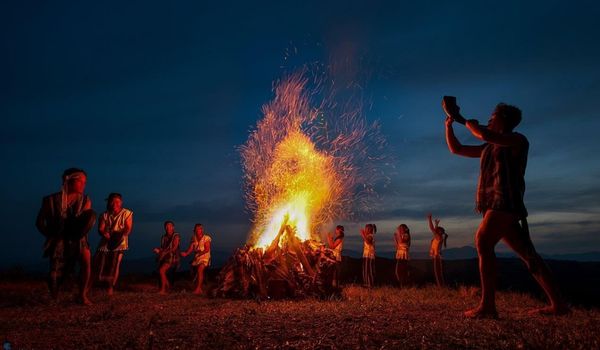
The space of gong culture is the second of Vietnam’s intangible cultural heritage elements
Behind every gong lies a god or goddess. Every family owns at least one gong, which indicates its wealth, authority and prestige. While a range of bronze instruments is used in different ceremonies, the gong alone is present in all the rituals of community life.
Each player holds a different gong measuring between 25 and 80 cm in diameter. Village ensembles of men or women play from three to twelve gongs. Different arrangements and rhythms suit the context of the ceremony, such as the ritual buffalo sacrifice, the blessing of the rice or mourning rites.
Quan Ho Bac Ninh folk songs
This is one of the first of Vietnam’s UNESCO intangible cultural heritage elements. Quan ho Bac Ninh folk songs have a particular format, in which two women from one village alternate with two men from another village to sing verses in harmony.
When singing Quan Ho Bac Ninh, recognised as intangible cultural heritage by UNESCO in 2009, the women, wearing large round hats (Non Quai Thao) and distinctive scarves, sing with emotion, expressing feelings such as longing and sadness at parting, as well as the joy of lovers reunited. The men reply with similar melodies but different words. Their traditional costumes include turbans, umbrellas and tunics.

This is one of the first of Vietnam’s UNESCO intangible cultural heritage elements
The lyrics of these songs reflect people’s deep emotions at separation and celebrate the happiness of being reunited with a loved one. Quan ho songs are often performed at rituals, festivals, competitions and informal gatherings. Guests join in, singing a variety of verses before saying goodbye.
Young male and female musicians have the chance to practise the four singing techniques - restrained, resonant, sonorous and staccato - during evenings devoted to this art form. The artistic expression of Quan ho goes beyond mere performance, demonstrating the spirit, philosophy and local identity of the region’s communities.
These events also help to strengthen social bonds within villages and between communities sharing this precious cultural practice. Quan ho songs thus play a significant role in preserving and celebrating the region’s cultural heritage.
Ca Tru singing
Inscribed on the List of Intangible Cultural Heritage in Need of Urgent Safeguarding, Ca tru is a complex form of sung poetry found in northern Vietnam, using lyrics written in traditional Vietnamese poetic forms.
Ca Tru groups consist of three performers: a female singer who uses breathing techniques and vibrato to create unique ornamented sounds while playing clappers or striking a wooden box, and two instrumentalists who produce the deep tones of a three-stringed lute and the strong beats of a praise drum.
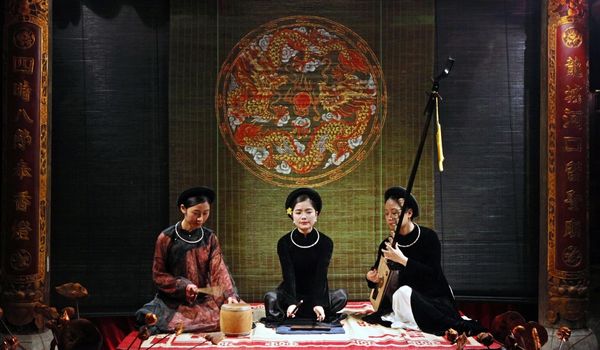
Ca Tru is inscribed on the List of Intangible Cultural Heritage in Need of Urgent Safeguarding
Some Ca tru performances also include dance. The various forms of Ca tru serve different social purposes, including worship singing, entertainment singing, singing in royal palaces and competitive singing.
Ca tru has 56 different musical forms or melodies, each called a “the cach”. It is a priceless heritage, but nowadays few young people take an interest in Ca Tru, making it an art that is gradually being forgotten. In 2009, Ca Tru was recognised by UNESCO as an intangible cultural heritage of Vietnam.
The Giong festival of Phu Ðông and Soc temples
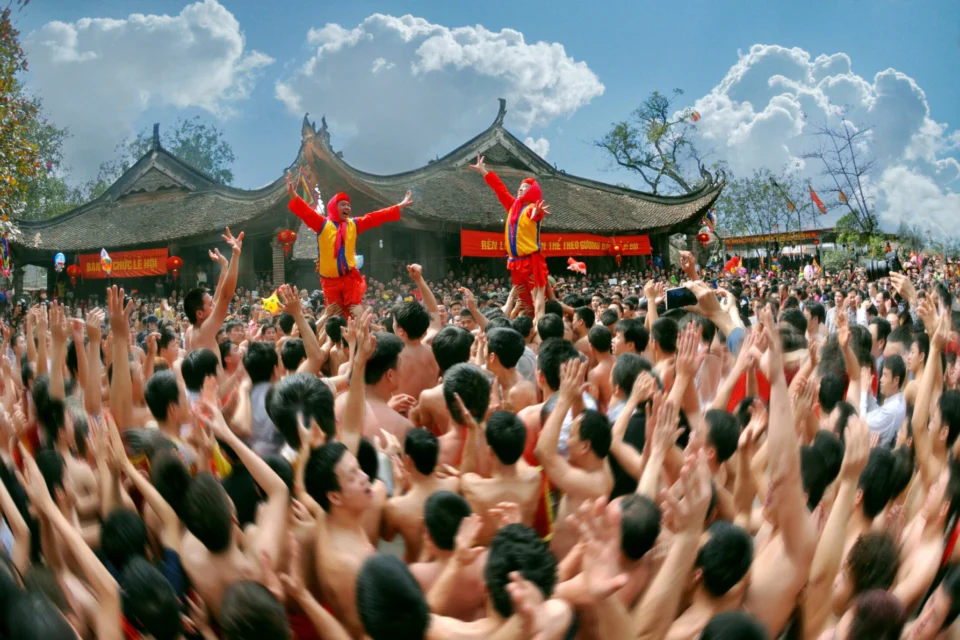
In 2010, the Giong festival of Phu Dong and Soc temples was recognised as one of Vietnam’s intangible cultural heritage elements. The festival is held every year in the outlying districts of Hanoi, the capital of Vietnam.
Every spring, before the rice harvest, the Vietnamese people honour the mythical hero, god and saint Thanh Giong, credited with defending the country against foreign enemies and worshipped as the patron god of the harvest, national peace and family prosperity.

In 2010, the Giong festival of Phu Dong and Soc temples was recognised as one of Vietnam’s intangible cultural heritage elements
The festival at Phu Dong temple, held in the fourth lunar month in his native village, symbolically re-enacts his exploits by riding a white horse into battle and performing an elaborate flag dance to symbolise the battle itself.
The arrival of the rains after the festival is seen as the saint’s blessing for an abundant harvest. The celebrations at Soc temple, where Saint Giong ascended to heaven, take place in the first lunar month and include the ritual bathing of his statue and a procession of bamboo flowers to the temple as offerings to the saint.
The worship of the Hung Kings
Phu Tho is a culturally rich province with 2 of Vietnam’s UNESCO intangible cultural heritage elements; along with Xoan singing, the worship of the Hung Kings brings together millions of worshippers every year, who gather to commemorate their ancestors and pray for good weather, abundant harvests, luck and good health.

The worship of the Hung Kings is one of Phu Tho province’s two UNESCO intangible cultural heritage elements
The largest ceremony, the ancestral anniversary of the Hung Kings, lasts about a week at the beginning of the third lunar month. During this period, residents of neighbouring villages dress in sumptuous costumes and compete to present the finest palanquin and the most precious objects of worship during the key rite, which involves carrying drums and gongs to the main temple site.
The participating communities make special rice-based offerings, such as square cakes and sticky rice cakes, while performances of verbal and folk arts, bronze drumming, Xoan singing and prayers and petitions punctuate the festivities.
These cultural and spiritual events help to perpetuate the tradition of Hung King worship, creating a vibrant atmosphere rich in heritage. In 2012, the worship of the Hung Kings was recognised by UNESCO as a cultural heritage of Vietnam.
The art of Don Ca Tai Tu music and song
The art of Don ca tai tu music and song is an essential part of the spiritual life and cultural heritage of the people of southern Vietnam. It was recognised by UNESCO in 2012 as an intangible cultural heritage element.
The music and songs evoke the life and work of people on the land and rivers of the Mekong Delta. Performed at many events such as festivals, rituals and death anniversaries, Don ca tai tu is closely linked to other cultural practices and customs, oral traditions and crafts.

The art of Don ca tai tu was recognised as an intangible cultural heritage element in 2012
Don ca tai tu is played on a variety of instruments, including the moon-shaped lute, the two-stringed fiddle, the sixteen-stringed zither, the pear-shaped lute, percussion, the monochord and the bamboo flute. Its repertoire is built around twenty main songs and seventy-two classical songs.
Musicians must study for at least three years to learn the basic instrumental techniques and master the musical modes used to express different moods and emotions. Singing students study the traditional songs and learn to improvise subtly using various ornamentation techniques.
Vi and Giam folk songs of Nghe Tinh
Vi and Giam songs are sung by a wide range of communities in the north-central provinces of Nghe An and Ha Tinh. They were recognised by UNESCO in 2014 as an intangible cultural heritage element.
Specific songs are sung without instrumental accompaniment while people tend rice in the fields, row boats, make conical hats or lull children to sleep.
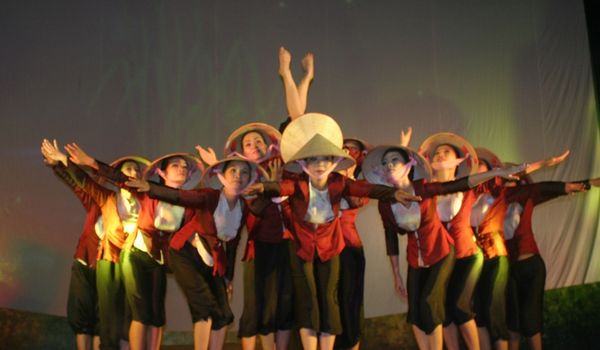
Vi and Giam songs were recognised by UNESCO in 2014 as an intangible cultural heritage element
The lyrics of Vi and Giam use the dialect and idioms specific to the Nghe Tinh region, and performers sing with the distinctive voice of the local people.
Many songs focus on key values and virtues, including respect for parents, loyalty, care and devotion, and the importance of honesty and kind-heartedness in maintaining village customs and traditions.
Singing gives people a chance to ease the hardship of work, relieve the sorrows of life, express feelings between men and women and exchange words of love between unmarried young men and women. Today, Vi and Giam are commonly performed at community cultural events and sung by artists in theatres.
Tugging rituals and games
Tugging rituals and games in the rice-growing cultures of East and South-East Asia are practised between communities to ensure abundant harvests and prosperity. In Vietnam, tugging rituals and games are concentrated in the Red River Delta and the north-central region.
They promote social solidarity, provide entertainment and mark the start of a new agricultural cycle. Many tugging rituals and games also have deep religious significance. Most variants involve two teams, each pulling one end of a rope in an attempt to pull it away from the other.

Keo Co
Tugging rituals and games are often held in front of a village’s communal house or shrine, preceded by commemorative rites honouring the local tutelary deities. Village elders play an active role in leading and organising the young people in playing the game and in organising the accompanying rituals.
They also serve to strengthen unity and solidarity, as well as a sense of belonging and identity among community members. The game was recognised by UNESCO as an intangible cultural heritage of humanity in 2015.
The Vietnamese practice of worshipping the Mother Goddesses of the Three Realms
To meet spiritual needs, fulfil everyday hopes and attract luck in various aspects of life such as health and work, several communities in Vietnam worship the Mother Goddesses of the Three Realms: the heavenly realm, the water realm and the realm of mountains and forests.
Among these Mother Goddesses, Lieu Hanh holds a special place. She is a fairy who came down to Earth and lived as a human being before becoming a Buddhist nun. She is known as the Mother of the World. Alongside Lieu Hanh, other spirits are also worshipped as legendary heroes.
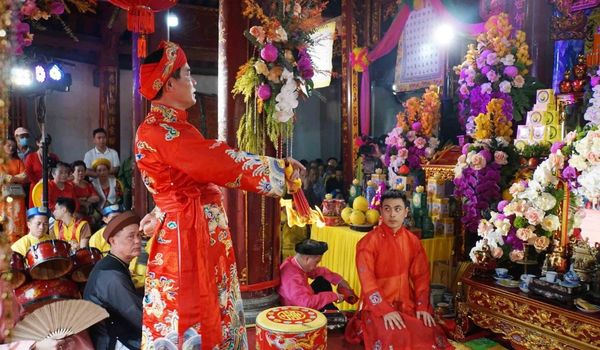
This belief was recognised by UNESCO as one of Vietnam’s intangible cultural heritage elements in 2016
This traditional spiritual practice encompasses various activities, including daily worship, participation in ceremonies, rituals such as spirit possession, and festivals such as that of Phu Day. These events take place in temples specially dedicated to the Mother Goddesses.
In addition, Mother Goddess worship plays a significant role in valuing women and their position in society, highlighting their importance and contribution. This belief was recognised by UNESCO as one of Vietnam’s intangible cultural heritage elements in 2016.
Bai Choi, the traditional art of central Vietnam
This is one of the two Vietnamese elements recognised as UNESCO intangible cultural heritage in 2017. The art of Bai Choi in central Vietnam is a diverse art form combining music, poetry, theatre, painting and literature. It is expressed mainly in two distinct forms: Bai Choi games and Bai Choi performances.

Bai Choi is one of the two Vietnamese elements recognised as UNESCO intangible cultural heritage in 2017
Bai Choi games take place during the Lunar New Year and involve a card game played in bamboo huts. Bai Choi performances, meanwhile, feature male and female artists on a rattan mat, either touring or on private family occasions.
This art holds an important place in the culture and leisure of village communities. Artists and their families play a crucial role in preserving the practice by teaching song repertoires, singing techniques, performance methods and card-making to the younger generations.
Xoan singing
Xoan singing is an art form combining singing, dancing, drums and clappers. Its cultural importance lies in its close link with the worship of the Hung Kings, a belief deeply rooted in the Vietnamese people’s practice of ancestor worship. It was recognised as a UNESCO intangible cultural heritage element in 2017.

Xoan singing was recognised as a UNESCO intangible cultural heritage element in 2017
To preserve and perpetuate this tradition, the bearers and practitioners of Xoan singing are organised into four guilds. Within these guilds, the male and female “Trum” play a central role. They are essential in preserving the songs, selecting students, passing on singing styles and repertoires, and organising practice.
Xoan singing is thus not just an artistic performance but is deeply embedded in the cultural and religious practice associated with the worship of the Hung Kings. The Trum play a crucial role in preserving and passing on this tradition, contributing to its vitality and reach within the community.
Then singing of the Tay, Nung and Thai ethnic groups
The practice of Then by the Tay, Nung and Thai ethnic groups of Vietnam was inscribed on the List of the Intangible Cultural Heritage of Humanity on 13 December 2019.
This practice is an art form combining a wide range of arts such as literature, music, painting and performance. It is an essential part of the spiritual life of the Tay, Nung and Thai peoples, reflecting their conceptions of humanity, the world and the universe.
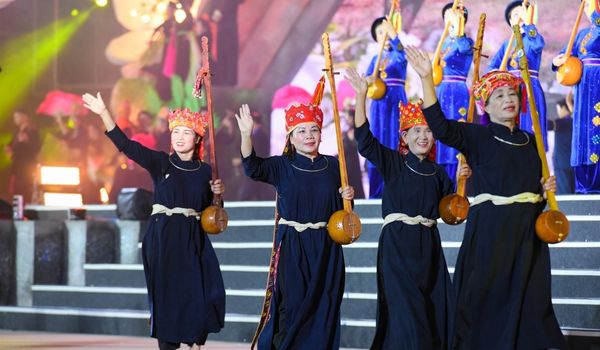
Then
It is performed at major New Year and ploughing celebrations, as well as at rituals wishing for safety, fortune and good harvests.
Then singing is practised in many northern provinces, namely Bac Giang, Bac Kan, Cao Bang, Ha Giang, Lang Son, Quang Ninh, Thai Nguyen and Tuyen Quang in the north-east; Dien Bien, Lai Chau and Lao Cai in the north-west; and several other localities in Vietnam.
The Xoe Thai dance
Xoe Thai is a unique type of traditional dance that is associated with and plays an important role in the daily life of the Thai ethnic communities of north-western Vietnam, especially in the provinces of Lai Chau, Dien Bien, Son La and Yen Bai. It was recognised by UNESCO as an intangible cultural heritage element in 2021.

Xoe Thai is a unique type of traditional dance recognised by UNESCO as an intangible cultural heritage element
In the language of the Thai people, “xoe” means dance, with movements representing people’s activities in rituals, daily life and work. It is performed at various community events, from festivals to funeral rites. The dancers are members of the Thai community, regardless of gender, age, occupation or social status.
With gentle, captivating rhythms, the dancers usually form a circle around a festive fire and move to the sound of melodious traditional music.
The pottery art of the Cham people
Of Vietnam’s UNESCO intangible cultural heritage elements, this is the most recent, recognised in 2022. Cham pottery, mainly household utensils, objects of worship and works of art such as jars, pots, trays and vases, is made using a unique approach. It reflects the individual creativity of Cham women, passed down within the community.
Cham pottery is not glazed but fired in the open over a fire of wood and straw, reaching a temperature of about 800°C for seven to eight hours. The raw materials, such as clay, sand, water, wood and straw, come from local sources. Knowledge and skills are passed down within families, from generation to generation, through practice.
This practice is passed on to children, strengthening the role of women in Cham society. It is also an essential source of income, helping to preserve the practices, customs and cultural identities of the Cham people in Vietnam.
Despite significant safeguarding efforts, the viability of this art is threatened for several reasons. Urbanisation affects access to raw materials, adaptation to the market economy remains insufficient, and young people’s interest in this tradition is declining. Preserving Cham pottery therefore requires continued attention and suitable solutions to overcome these challenges.
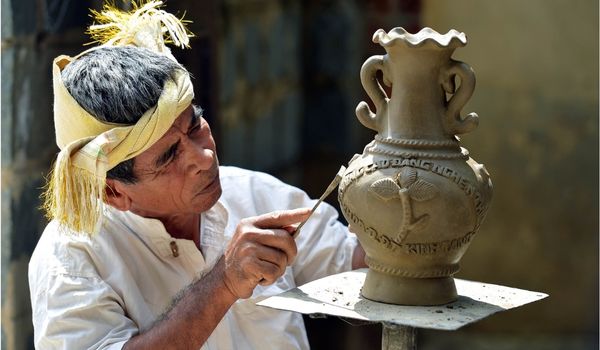
This art form is the most recent to be recognised among UNESCO’s intangible cultural heritage elements
This practice is passed on to children, strengthening the role of women in Cham society. It is also an essential source of income, helping to preserve the practices, customs and cultural identities of the Cham people in Vietnam.
Despite significant safeguarding efforts, the viability of this art is threatened for several reasons. Urbanisation affects access to raw materials, adaptation to the market economy remains insufficient, and young people’s interest in this tradition is declining. Preserving Cham pottery therefore requires continued attention and suitable solutions to overcome these challenges.
Last checked Suggest a correction
Sources