
1. Mi Quang: the heritage jewel of the land of Quang
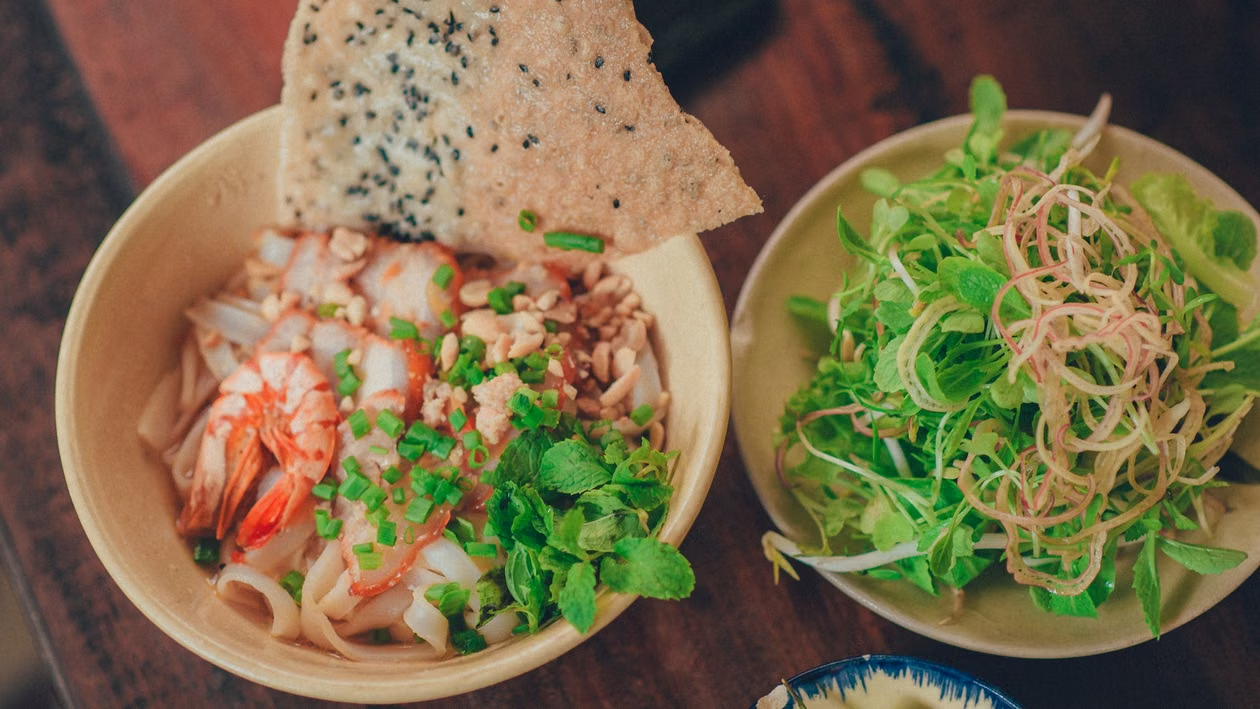
Quang noodles served with grilled rice crackers. Photo: Min An
More than just a dish, Mi Quang is a cultural institution, a symbol of belonging for the whole of Central Vietnam. What immediately sets it apart from other Asian noodle soups is its subtle balance between dry and wet: the noodles don't swim in an abundant broth but are simply moistened with two or three ladles of a highly concentrated liquid, rich in fat and cooking juices (nuoc leo). The wide, thick noodles, made from local rice batter lightly brushed with roasted peanut oil, sometimes have a bright yellow colour that comes naturally from fresh turmeric.
The toppings vary endlessly from stall to stall: river prawns simmered in their shells, slices of caramelised pork belly, free-range chicken sautéed with shallots, or even hard-boiled quail eggs. The true signature of Mi Quang, however, lies in its fresh and crunchy accompaniments: a generous basket of at least nine fresh herbs and greens (finely shredded banana blossom, Thai basil, coriander, young mustard leaves), a handful of crushed roasted peanuts, crunchy green chillies to bite into, and a large crispy sesame rice cracker (banh trang nuong) crumbled straight over the bowl. Eating it becomes a symphony of textures in which the soft noodles answer the crunch of the peanuts and the grilled cracker.
2. Pork rolled in rice paper: the ritual of fresh produce

The key ingredient is pork belly. Photo: Bui Thuy
The ultimate convivial and refreshing dish, banh trang cuon thit heo depends entirely on rigorous ingredient selection and meticulous slicing. The key ingredient is pork belly (thit heo hai dau da), boiled with jeweller's precision in an aromatic broth so that the meat stays juicy. It is then cut into translucently thin slices, revealing the feature Da Nang gourmets look for: a band of red meat sandwiched between thin edges of fat and rind at both ends.
The art of this dish lies in the ritual of assembling it at the table. Diners take a sheet of rice paper dried in the sea air, lay on it an ultra-thin, soft steamed rice sheet (banh uot), then add a slice of pork with a bunch of herbs (mint, rau ram, basil), cucumber sticks, slices of astringent green banana and tangy green mango. The finished roll is dipped into a bowl of mam nem - a pungent fermented fish sauce typical of Central Vietnam, skilfully softened with blended fresh pineapple, crushed garlic, cane sugar and red chilli. The explosion of flavours brings together the freshness of the raw vegetables, the tenderness of the pork and the bewitching aromatic power of the sauce.
3. Fish cake noodle soup: the briny essence of the coast
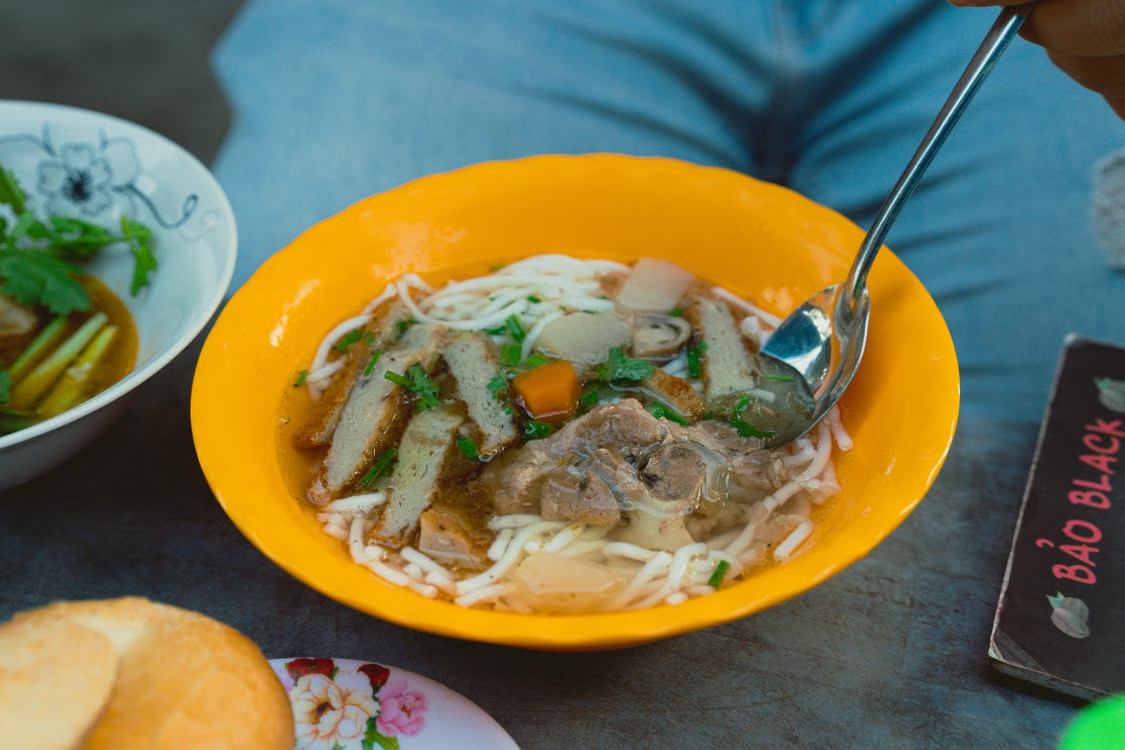
(illustrative image). Photo: Theodore Nguyen
Thanks to its long seafront, Da Nang has made bun cha ca the comforting breakfast of choice for coastal residents. The dish's success rests on two pillars: the quality of the fish cakes (cha ca) and the aromatic clarity of the broth. The fish cakes are made from the fresh flesh of deep-sea fish - often mackerel, grouper or scad - , pounded with black pepper, shallots and a touch of pure fish sauce. The paste is then divided: part is fried to get a golden, flavourful crust, while the rest is steamed to keep a soft texture and pearly colour.
The broth, meanwhile, is a marvel of sweet-and-sour balance. Made by long simmering of carefully cleaned fish heads and bones, it is clarified and then infused with pieces of sweet red pumpkin, wedges of ripe tomato, slices of fresh pineapple, bamboo shoots and Chinese cabbage. This combination brings a natural vegetable sweetness that neutralises any strong fishy note. Served piping hot over thin rice vermicelli, the soup comes with a spoonful of chilli fried in oil, crushed garlic and a plate of shredded green salad.
4. Bun mam nem: the intense symphony of the working-class districts
For food lovers seeking bold flavours with character, bun mam nem is the most authentic and daring expression of Da Nang's street food. Unlike hot soups, it consists of cold rice noodles laid at the bottom of a large bowl and covered with a particularly generous and varied topping. You will find roast pork with puffed, crackling skin (thit heo quay), slices of traditional beef sausage (cha bo), pieces of crunchy pig's ear or fermented pork (nem chua).
But the real conductor of this dish is the mam nem. This pungent, amber whole-fish fermented sauce is prepared to closely guarded family recipes: it is blended with fresh pineapple purée for body and sweetness, then seasoned with lime juice, sugar, crushed garlic and a generous amount of dried red chilli. Before eating, the bowl is dressed with this bewitching sauce, then topped with boiled and shredded young jackfruit, roasted peanuts and mixed salad. Tossed quickly, every mouthful offers an explosive alliance of salty, spicy, crunchy and the seductive aroma of sea fermentation.
5. Peppered beef sausage (Cha bo Da Nang): the craft of an exceptional speciality

Peppered beef sausage. Photo: Tran Kim Anh
Known throughout Vietnam as one of the city's most prestigious food souvenirs, Da Nang cha bo stands apart from industrial sausages for its purity and demanding production. It is made exclusively from fresh, lean beef (from the leg or fillet), processed immediately after slaughter while the muscle fibres still keep their natural elasticity. All sinews and fat are meticulously removed by hand before the meat is pounded.
The traditional recipe forbids flour, starch or artificial preservatives. The seasoning stays minimal to let the quality of the meat shine: pure first-press fish sauce, cane sugar, fresh garlic and above all a generous quantity of whole or coarsely crushed black peppercorns. The pounded meat is then wrapped in many layers of fresh banana leaves - which lend a subtle green fragrance during cooking - and steamed at a controlled temperature. When sliced, cha bo reveals a beautiful deep pink colour and a texture at once firm, springy and extremely juicy, releasing in every bite tasty meat juices lifted by the warm bite of black pepper.
Next come the other five specialities of Da Nang (6 to 10):
6. Banh xeo & Nem lui: the crispy duo and its liver sauce
While rice pancakes are found all over Vietnam, the Da Nang version has a distinct identity: it is smaller, golden with turmeric, and its batter is fried in small cast-iron pans until it forms an ultra-crispy crust, almost brittle at the edges. Inside are whole sea prawns, thin pieces of pork belly and a handful of crunchy bean sprouts.
The traditional set: Banh xeo, Nem lui and condiments. Photo: Bruce Yuanyue Bi
The dish is rarely eaten on its own: it comes with nem lui, skewers of seasoned minced pork wrapped around a stalk of spring onion or lemongrass and grilled over glowing charcoal. To eat it, you cut a piece of hot pancake, add a grilled skewer, a few mustard leaves, grated green banana and tangy mango, and roll everything up tightly in a thin sheet of rice paper. The real magic lies in the dipping sauce (nuoc tuong): a warm, velvety brown cream made from pounded pork liver, sesame seeds, ground peanuts and fermented soybean paste.
7. Da Nang chicken rice: the golden harmony of grain and poultry
Inspired by the tradition of neighbouring Hoi An but adapted to the rhythm of the big coastal city, chicken rice is a model of elevated simplicity. It starts with the rice: the grains are first toasted dry in a pan with garlic oil and freshly ground turmeric, then cooked directly in rich chicken stock. The rice thus absorbs all the richness of the stock, taking on a sunny yellow colour, a soft texture and an irresistible aroma.
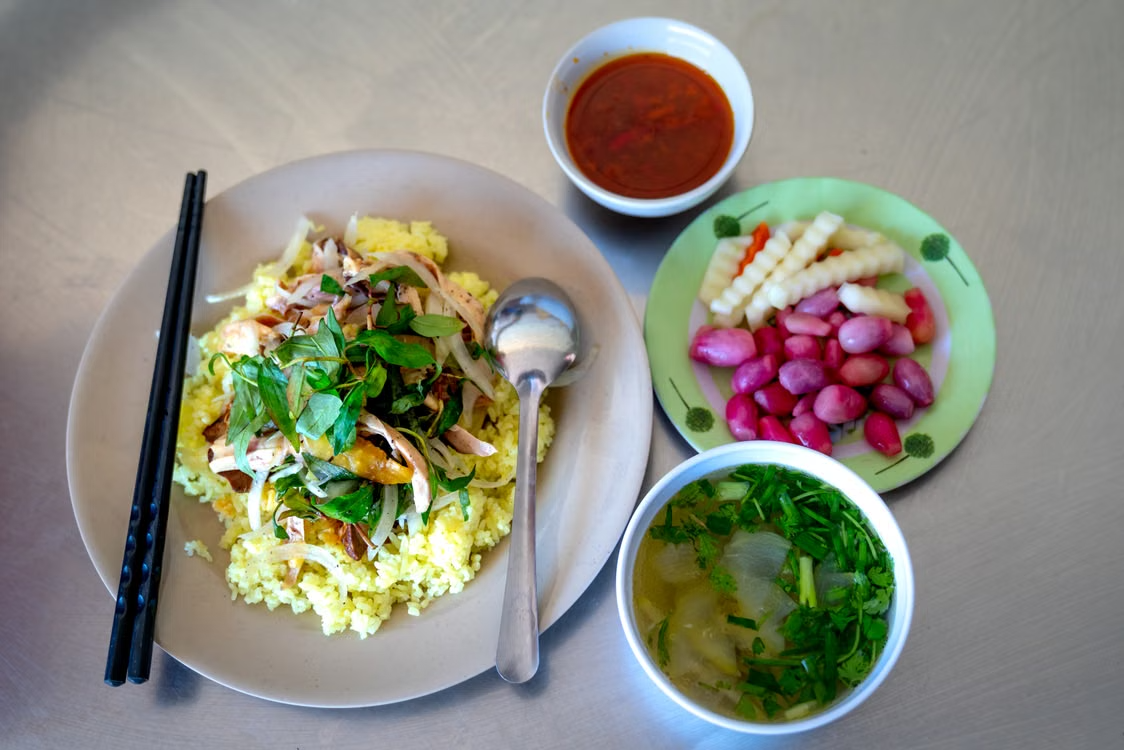
Da Nang chicken rice. Photo: Quang Nguyen Vinh
The chicken comes exclusively from free-range birds (ga tha vuon), known for their firm, juicy meat and crisp skin. After steaming, the meat is shredded by hand and seasoned with a squeeze of lime, black pepper, thinly sliced onion and Vietnamese coriander (rau ram). The dish is served with a small bowl of clear broth scented with spring onion and a homemade sweet chilli sauce to bring it all together.
8. Coastal seafood: the raw freshness of the ocean
You can't visit this seaside city without devoting an evening to the seafood stalls lining the coast. The restaurants display the day's catch in large seawater tanks: blue crabs, king prawns, cuttlefish, chip chip shellfish (small local clams) and sea snails.
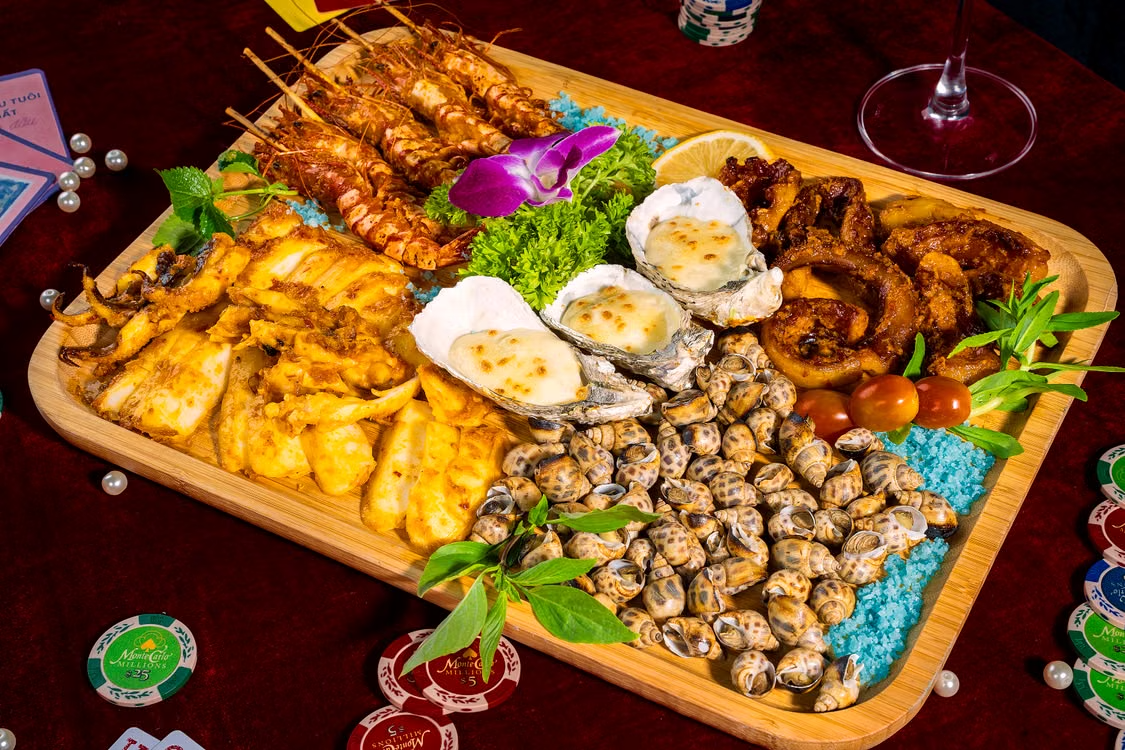
Coastal seafood. Photo: Dau Photograph
The local culinary philosophy favours very simple preparations to preserve the original taste of the sea. The most popular speciality is chip chip hap sa: these small clams are steamed in a punchy broth of crushed lemongrass, chilli and Thai basil. The clear, concentrated juice released by the shellfish is eaten with a spoon, while the tender flesh is dipped in a small dish of salt, black pepper and fresh lime juice.
9. Tapioca noodle soup with snakehead fish (Banh canh ca loc): velvety comfort
A popular dish par excellence, often enjoyed in the evening at small stalls lit by candles or neon, banh canh is known for its thick, chewy noodles made from tapioca flour (bot loc) or a mixture of rice and tapioca.
The snakehead fish (ca loc) is first steamed, then its flesh is carefully removed and marinated with annatto oil (which gives it a lovely orange colour), plenty of black pepper and shallots. The bones and head go back into the pot to make a rich broth, naturally thickened by the starch of the noodles. Served in large, very hot bowls, the soup is topped with melting pieces of fish, hard-boiled quail eggs and sometimes crispy pork cracklings (top mo).
10. Snails stir-fried with chilli and lemongrass (Oc hut Da Nang): the spicy ritual of the back streets
A true institution of Da Nang's street-food culture, oc hut (literally “snails for sucking”) is the go-to late-afternoon treat. Different varieties of freshwater snails (oc dang, oc buou) or sea snails are carefully cleaned, then the tip of their shells is snipped off with small pliers before cooking.
Snails stir-fried with lemongrass and fresh chilli. Photo: monticelllo
The snails are simmered in large basins with plenty of crushed lemongrass, fresh chilli, kaffir lime leaves and coconut milk. To eat them, you bring the opening of the shell to your mouth and suck sharply to free the flesh soaked in the spicy broth. The dish always comes with a plate of crunchy green papaya or mango strips to soothe the heat of the chilli.